Published by Christopher J. Holley | Mopar History & Tech | August 2025
There are a few moments in the history of Detroit’s golden age when a single styling theme reshaped the uniqueness of an entire automaker. For Chrysler Corporation, that defining moment came in 1955, when Virgil Exner’s Forward Look swept away decades of traditionalistic design and ushered in a bold new era. These were not cars that whispered or blended into traffic. They were cars that shouted, cars that soared, and cars that embodied the Jet Age spirit of a nation that was moving faster than ever before.
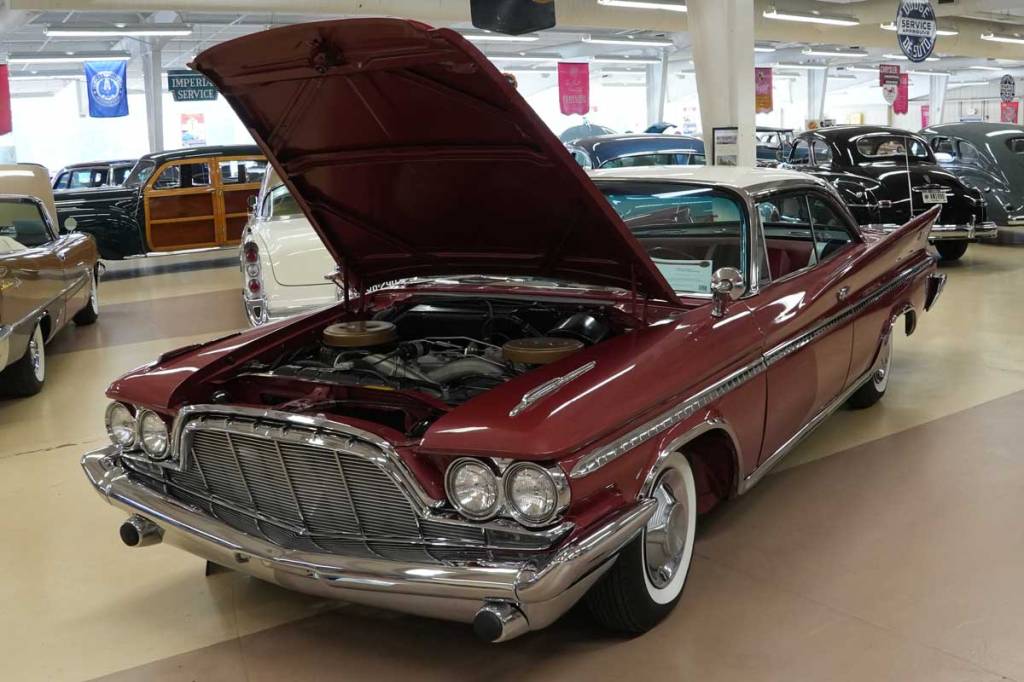
Today, more than sixty years later, the Forward Look remains one of the most spectacular chapters in American automotive history. At a car show or museum, it is impossible to miss them. Their fins stab skyward, their profiles stretch low and sleek, and their chrome gleams with the optimism of the 1950s. But to understand why they are worth so much attention today, you have to step back into the world that created them.
Chrysler Before Exner: The Stodgy Years
In the early 1950s, Chrysler had a problem. Its cars were known for their engineering excellence, durable drivetrains, powerful Hemi V8s, and industry-leading safety features, but they lacked style. While GM under Harley Earl was dazzling the public with chrome-laden Chevrolets, Buicks, and Cadillacs, and Ford was selling cars on flash and affordability, Chrysler’s lineup looked plain. Competent, yes. Exciting, no.
Chrysler was the automaker of accountants, bankers, and engineers. Solid transportation, but not the kind of car that a teenager would dream about or a suburban dad would boast about to the neighbors. Chrysler’s management knew something had to change, and the man who would deliver that change was designer Virgil Exner.
Virgil Exner and the Birth of the Forward Look
Exner, who had honed his craft at Studebaker, joined Chrysler in 1949 and quickly began reshaping the company’s design philosophy. Where others saw incremental updates, Exner saw an opportunity to leapfrog the competition. His philosophy was captured in the tagline: “Suddenly, it’s 1960.”
That was not just marketing hype. When Chrysler’s 1955 lineup hit the streets, they looked like nothing else in America. Low, wide, and modern, they seemed to jump half a decade ahead of schedule. The fins were small at first, subtle nods to aviation and jet design, but they set the stage for what was coming.
Exner believed that cars should capture the imagination, that they should appear to be in motion even when parked at the curb. By 1957, his vision reached full flight. The entire Chrysler lineup, Plymouth, Dodge, DeSoto, Chrysler, and Imperial, was redesigned in dramatic fashion. The cars were longer, lower, and adorned with tailfins that soared into the sky.
Fins, Flight, and Fantasy
To understand the appeal of the Forward Look, you have to picture the cultural backdrop of the late 1950s. America was obsessed with rockets, jet planes, and the promise of space travel. The first satellites were going into orbit. Supersonic flight was becoming a reality. The future felt closer every day.
The Forward Look tapped into that excitement. These cars did not just borrow inspiration from airplanes; they seemed ready to take off. Sweeping side panels drew the eye rearward, where massive fins and glowing taillamps evoked jet exhausts. Wraparound windshields gave drivers the feeling of sitting in a cockpit. Even the interiors reflected the Jet Age, with push-button controls and futuristic instrument clusters.
For many families, buying a Chrysler product in those years was not just a transportation decision; it was a way of staking a claim to modernity. You were not driving yesterday’s car. You were driving tomorrow’s.
Engineering to Match the Show
Unlike some automakers who let styling get ahead of substance, Chrysler backed up the Forward Look with real engineering credibility. Under the hoods, the company offered engines that ranged from strong straight-sixes to fire-breathing Hemis. The 300 “letter cars” in particular, beginning with the 1955 300, often called America’s first muscle car, proved that Chrysler could deliver serious performance in addition to glamour.
Then there was the innovation. In 1956, Chrysler introduced its push-button TorqueFlite automatic transmission, a futuristic feature that fit perfectly with the theme. In 1957, the Torsion-Aire suspension was introduced, a torsion-bar front setup that improved both ride and handling, giving Mopars a reputation for being more composed on the road than their floaty GM counterparts. By 1960, Chrysler had moved to unibody construction, reducing weight and improving rigidity years before the rest of the industry followed suit.
These cars were not just pretty. They drove well, and in many cases, they outperformed the competition.
Flaws in the Dream
Of course, no story is without its flaws. In Chrysler’s eagerness to get the 1957 redesign into showrooms, quality control slipped. Rushed production schedules led to poor assembly and rust problems that plagued the cars almost immediately. For many owners, the Forward Look cars did not last nearly as long as they should have.
That, ironically, is part of their appeal today. Survivors are rare, especially in original condition. A ’57 Plymouth Fury or Chrysler 300C that still wears its factory sheet metal is a true prize. Restorers often face monumental challenges, but when the work is done, the payoff is one of the most visually striking cars of its era.
The Collector’s Market Today
Walk through a major car show, and you will see the crowds gather when a Forward Look Chrysler appears. A 1960 DeSoto Adventurer, a 1957 Imperial Crown, or a Plymouth Belvedere with its fins slicing through the air; these are the cars people gravitate toward. They are not just automobiles; they are sculptures from an age when designers were not afraid to dream.
Values have followed that attention. While they may not command the stratospheric prices of some ’60s muscle cars, the best Forward Look examples, especially the letter-series Chryslers, are highly desirable among collectors. Their rarity, combined with their unmistakable style, ensures that they will always hold a special place in the hobby.
Why They Still Matter
The reason the Forward Look cars still resonate today goes past fins and chrome. They represent a moment in time when an automaker chose boldness over caution, when designers and engineers worked in harmony to create something truly forward-thinking.
They remind us of a time when America believed the future was bright and limitless, when cars were more than machines; they were rolling statements of optimism.
So, when one of these Mopars rumbles into view today, people cannot help but stop and stare. They are seeing more than a car. They are seeing a dream from the Jet Age made real in steel, glass, and chrome.
And that dream, like the soaring fins of a ’57 Chrysler, still points to the sky.
 Mopower Garage
Leave a comment