Published by Christopher J. Holley | Mopar History & Tech | September 2025
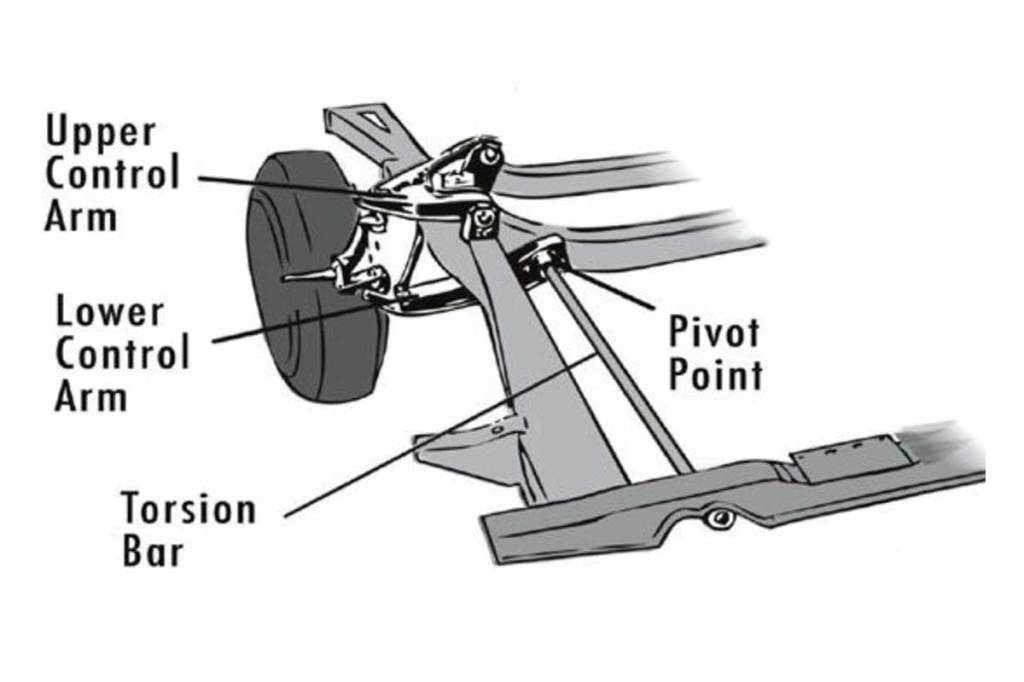
Chrysler’s torsion-bar front suspension, introduced across their cars in 1957 and used in various forms through the late 1970s (and in trucks until the 2000s), was one of the brand’s signature engineering features. It set Mopars apart from GM and Ford, who used coil springs up front. Like any suspension design, it came with both advantages and disadvantages.
Benefits of Chrysler’s Torsion-Bar Front Suspension
1. Adjustability
- Ride height could be easily adjusted with just a ratchet by turning the torsion bar anchor bolts.
- This was useful for correcting sag over time, setting custom stance (lower for handling, higher for clearance), or compensating for heavy-duty use (towing, plowing, etc.).
2. Durability & Longevity
- Torsion bars were extremely tough and resisted sagging better than coil springs.
- Less prone to breaking down under heavy loads or after years of use compared to coils.
3. Packaging Advantages
- Bars ran longitudinally (front to rear), freeing up space in the engine bay compared to coil springs.
- This helped Chrysler design lower-profile front suspensions and sleeker car styling in the late ’50s.
4. Ride & Handling Balance
- Chrysler engineers could tune bars to achieve a smoother ride without sacrificing handling.
- Provided a more controlled ride on rougher roads compared to some coil setups of the time.
5. Weight Distribution
- Lower unsprung weight than coil-spring setups in certain applications, improving road feel and agility.
- Mopars in the ’60s and ’70s were often praised for handling better than comparable GM or Ford muscle cars.
6. Simplicity
- Fewer parts than a coil-spring system (no spring pocket, less structural bracing).
- Easier and cheaper to manufacture in some respects.
Disadvantages of Chrysler’s Torsion-Bar Front Suspension
1. Ride Quality Variability
- While capable of good handling, torsion bars could feel harsher over bumps compared to well-tuned coils.
- Some owners felt Mopars rode more stiffly than GM cars of the same era.
2. Suspension Travel Limitations
- Torsion bars limited the total amount of vertical wheel travel compared to coils.
- On rough roads or off-road, they could top/bottom out more easily.
3. Space Trade-Offs
- Bars ran under the car to the rear crossmember, sometimes complicating exhaust routing or transmission swaps.
- On trucks, the layout could slightly reduce ground clearance versus coils.
4. Fatigue & Breakage (Long-Term)
- Though tough, bars could eventually twist-fatigue and snap, though rare, it was catastrophic when it happened.
- Rust or improper adjustment sometimes accelerated failures.
5. Limited Aftermarket Support Today
- Coil-over conversions are more common in modern performance suspension upgrades.
- Replacement bars are less available compared to coil springs, limiting tuning options unless you go aftermarket (e.g., Mopar Performance or aftermarket bars).
6. Uneven Adjustment Risks
- Because ride height was adjustable, improper adjustment could cause handling issues (uneven heights, poor alignment, premature tire wear).
In short: Chrysler’s torsion-bar suspension was innovative, durable, and gave Mopars superior adjustability and handling edge in the muscle car era. But it had limits in ride comfort and suspension travel, and today it is harder to tune or upgrade compared to coil-based systems.
Mopar Torsion Bars vs. GM & Ford Coil-Spring Front Suspensions
1. Handling & Cornering
- Mopar (Torsion Bar)
- Mopar B- and E-bodies (’60s–’70s Road Runners, Chargers, ’Cudas, Challengers) were often praised for their balanced handling.
- Torsion bars provided flatter cornering and more predictable turn-in compared to the soft coil springs in many GM/Ford cars.
- Chrysler’s engineers deliberately tuned suspensions for handling (the “Firm Feel” engineering philosophy).
- GM/Ford (Coils)
- GM A-bodies (Chevelle, GTO) and Ford intermediates (Fairlane, Torino) typically had softer front coils that made for comfortable straight-line rides but more body roll in corners.
- Muscle cars from these brands were often “point and shoot,” fast in a straight line but less nimble in curves.
Advantage: Mopar.
2. Adjustability & Stance
- Mopar (Torsion Bar)
- Ride height could be easily adjusted with a wrench, racers often cranked bars up or down to fine-tune weight transfer for drag racing or to lower the car for handling.
- Great for owners who wanted dual-purpose street/strip setups.
- GM/Ford (Coils)
- To change ride height, you had to swap springs, cut coils, or use spacers.
- Much less convenient for the average owner.
Advantage: Mopar.
3. Durability & Longevity
- Mopar (Torsion Bar)
- Bars rarely sagged like coils did. Cars often maintained proper ride height for decades.
- Breakage was rare but catastrophic if it occurred.
- GM/Ford (Coils)
- Coil springs tended to sag over time, especially in big-block cars, leading to nose-down stances and uneven handling.
- Replacement was common after 5–10 years of use.
Advantage: Mopar.
4. Ride Comfort
- Mopar (Torsion Bar)
- Ride could be firm and sometimes harsh, especially with heavy-duty suspension packages (R/T, Super Track Pak, etc.).
- Long bars in big cars (like Imperials) gave a smoother ride, but shorter bars in A-bodies could feel stiff.
- GM/Ford (Coils)
- Coil springs generally provided a softer, more cushioned ride.
- Better suited for boulevard cruising than spirited back-road driving.
Advantage: GM/Ford.
5. Packaging & Design
- Mopar (Torsion Bar)
- Freed up engine bay space for big engines (important for Chrysler’s big-block Hemis and wedge motors).
- Allowed Mopars to have a lower hood line in the late ’50s and ’60s, influencing styling.
- GM/Ford (Coils)
- Coils took up more vertical space, sometimes limiting engine bay packaging.
- But simpler in terms of undercarriage layout.
Advantage: Mopar.
6. Track & Competition Results
- Road tests of the time often noted that Mopars felt more controlled and better balanced in corners.
- In Trans-Am racing, Dodge Challengers and Plymouth ’Cudas benefitted from their suspension setups, though GM’s Camaro/Z28 and Ford’s Boss Mustangs had strong factory racing support.
- For drag racing, adjustability of torsion bars helped Mopar racers fine-tune weight transfer, a big plus.
Summary
- Mopar Torsion Bars = Better handling, more durable, adjustable, and advanced for their time.
- GM/Ford Coils = Softer ride, cheaper to build, easier aftermarket support today.
In the muscle car era, Mopars had a reputation as the best-handling Detroit cars right out of the box, largely thanks to torsion-bar front suspension combined with leaf-spring rears.
 Mopower Garage
Leave a comment