
Published by Christopher J. Holley | Mopar History & Tech | October 2025
By 1968, Detroit’s muscle car war had gotten a little too grandiloquent. What started as a simple recipe, big engine, small car, had ballooned into a game of chrome, stripes, and sticker shock. The Pontiac GTO had gone upscale. The Chevelle SS was edging toward luxury. Even Mopar’s own GTX, while brutally quick, had drifted into the “gentleman’s hot rod” category.
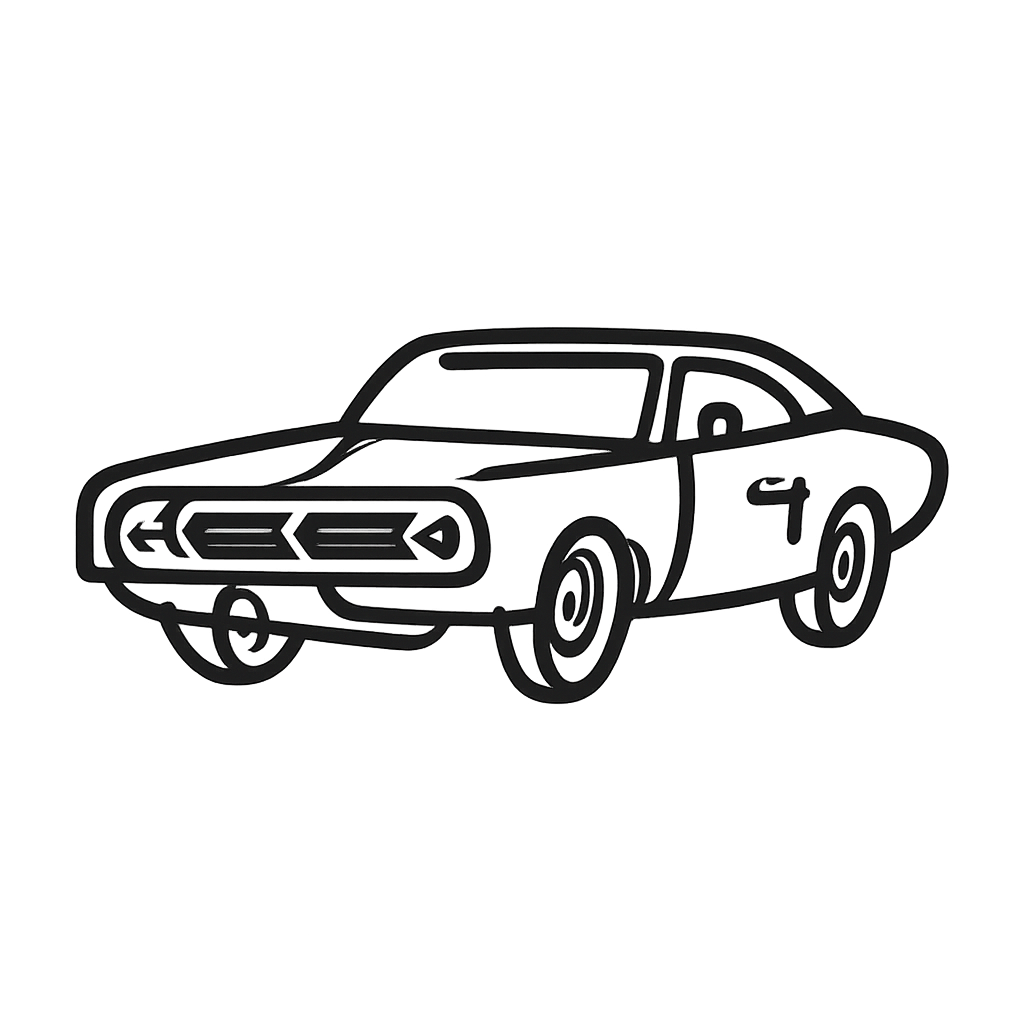
Then Plymouth did something brilliantly rebellious: it built a car that stripped all the nonsense away and got right back to the point. The result was the 1968 Plymouth Road Runner, a blue-collar muscle car that hit the streets like a hand grenade with the pin pulled.
At its core, the Road Runner was a return to the muscle car’s working-class roots. The base model came with Chrysler’s 383-cubic-inch V8, beefed up with big-port heads, a high-lift cam, and a four-barrel carburetor, good for 335 horsepower and a solid mid-14-second quarter mile potential right off the showroom floor. All that power came wrapped in the stripped-down body of a Belvedere coupe, with rubber mats instead of carpet and a bench seat instead of buckets. If you wanted luxury, you were in the wrong showroom. But if you wanted to bang gears and raise hell, this was your machine.
And it was cheap, ridiculously cheap. A base Road Runner stickered for under $3,000, which meant a kid working at the mill could afford one. The engineers and marketers knew precisely what they were doing: keep it light, keep it loud, and keep it honest. Plymouth even paid Warner Bros. $50,000 for the rights to use the cartoon bird’s name and likeness. They added a “Beep-Beep” horn, and suddenly the car had personality, half menace, half mischief.
The performance lived up to the image. Testers were shocked at how hard the Road Runner hit for the money. With a 4-speed and 3.91 gears, it was a factory street racer that could take on cars costing hundreds more. And if you wanted to go full maniac, you could check one little box on the order sheet and get the legendary 426 Hemi, 425 horsepower of pure, race-bred thunder. In 1968, that was as close as possible to getting a Super Stock car with a warranty.
But beyond the numbers, the Road Runner captured something cultural. America was tense, Vietnam, protests, assassinations, but this car did not care about politics or pretense. It was about joy in motion, about a burnout on a Friday night, about a 383 echoing off the walls of a drive-in. It reminded people that cars could still be fun.
Plymouth planned to sell around 20,000 of them in that first year. They ended up building nearly 45,000. The Road Runner was not just a hit; it was a statement.
In a decade of excess, it brought back the purity of performance. It was not beautiful (well, it was too many), it was not refined, and that was precisely the point. It was the car that laughed in the face of luxury and made the muscle car fun again.
 Mopower Garage
Leave a comment