Published by Christopher J. Holley | Mopar History & Tech | October 2025
It was 1968, and Detroit was deep in the horsepower wars. Big blocks ruled the boulevards; sober, loud, and unapologetic. But over at Highland Park, Chrysler had a different belief. What if a small-block could do the job of a big-block, and do it better? The answer was the 340, a purpose-built high-performance V8 that rewrote what “small block” meant. Lightweight, free-revving, and brutally tough, the 340 did not just hold its own against bigger engines; it embarrassed them.
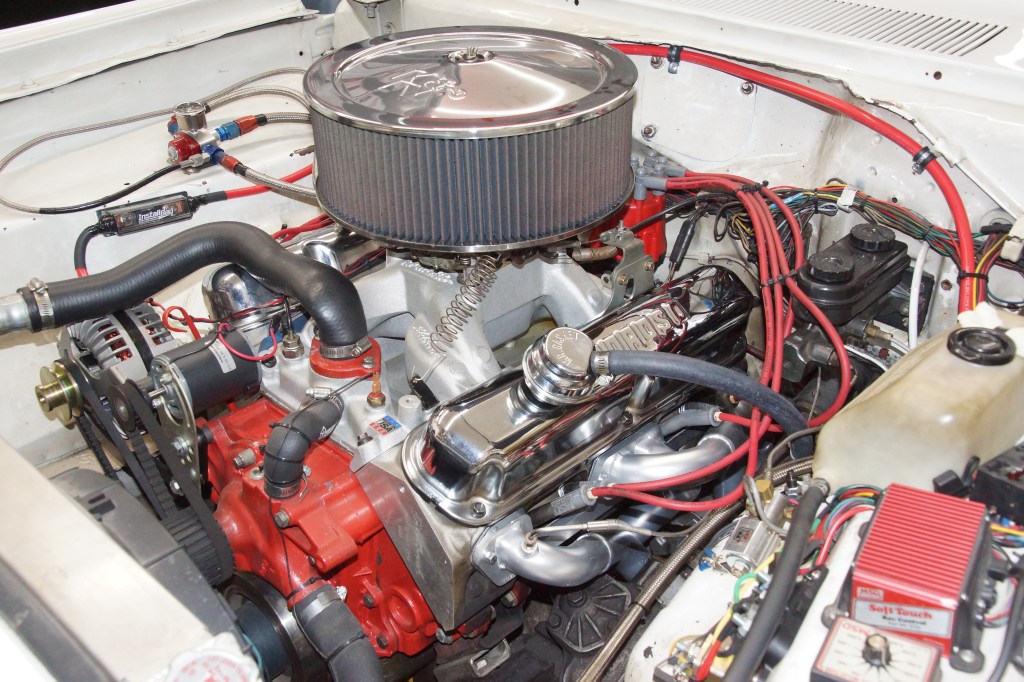
The 340 was not a bored-out 318 or a repackaged truck motor. It was a clean-sheet performance design from top to bottom. Chrysler engineers gave it a 4.04-inch bore and a 3.31-inch stroke, creating an oversquare layout that begged for rpm. Under the orange paint, the 340 was loaded with race-grade internals: a forged steel crankshaft and rods, 10.5:1 compression forged pistons, a high-nickel “X” block casting for strength, and a windage tray to control oil at high rpm. Even its cylinder heads were special, with large 2.02-inch intake and 1.60-inch exhaust valves breathing through generous ports that let the engine rev cleanly past 6,500 rpm. The 340 was not just an engine; it was an overachiever in cast iron.
Factory numbers listed the 340 at 275 horsepower at 5,000 rpm and 340 lb-ft of torque at 3,200, but that was corporate modesty. Independent dyno pulls in the day showed more like 310 to 320 real horsepower, and the little small-block’s throttle response was razor sharp. In a lightweight A-body, the 340 turned Plymouth Dusters, Dodge Darts, and Swingers into giant killers. Many could run low-14s, or better, on stock bias-ply tires, and they handled better than any big-block street bruiser.
Where the 340 truly shined was in its breathing. The combination of high-flow heads, a Carter AVS four-barrel, and a well-designed dual-plane intake gave the engine a broad, flat torque curve. The result was power everywhere, from idle to red line. In 1970, Mopar turned the 340 loose in Trans Am trim. The Six-Pack 340, found in the AAR ’Cuda and T/A Challenger, wore triple Holley two-barrels and a wild cam profile. Officially rated at 290 hp, the Trans Am version was more like 350 real horsepower with 7,000-rpm durability.
Beyond performance, the 340 earned a reputation for indestructibility. Racers discovered you could buzz it to the moon and still drive it home. The forged crank and short stroke made it nearly bulletproof under high rpm stress, and even stock rods survived severe abuse. Street racers loved it for another reason: the 340’s lighter weight gave small A-bodies a perfect balance of power and handling. While big-block cars fought for traction, the 340 cars hooked and booked.
When emissions and insurance pressures stifled the muscle car era, the 340 declined to fade quietly. Enthusiasts learned that a hotter cam, better ignition, and a set of headers could transform a stock motor into a 12-second threat. Even after Chrysler replaced it with the 360 in 1974, the early high-compression 340 blocks became prized cores. Whether for drag racing, circle track, or resto-mod builds, the 340 remains the sweet spot of Mopar small-block engineering, an engine that blended brawn with brains.
The 340 was more than numbers; it was attitude. It represented everything that made late-’60s Mopar special: clever engineering, raw power, and a defiant streak a mile wide. Today, half a century later, devotees still pursue that same balance of torque, throttle, and toughness. Because when Chrysler got the small block right, they did not just make horsepower, they made history.
 Mopower Garage
Leave a comment