Published by Christopher J. Holley | Mopar History & Tech | October 2025
The 1968 Plymouth Road Runner did not just muscle its way into the spotlight; it laughed its way there. At a time when Detroit was locked in a horsepower arms race, Plymouth built a car that could tear up the quarter mile and still make you smile. It was not the rumble of its 383 that caught your ear first; it was the horn. A sharp, two-note “Beep-Beep!” that instantly became the most recognizable sound in American muscle.
That playful chirp was not an afterthought. It was part of the plan. When Plymouth engineers and marketers set out to create a no-frills performance car, they wanted something more than a stripped Belvedere with a big engine. They wanted personality. Someone in a meeting suggested naming it after the Looney Tunes cartoon bird that always outsmarted Wile E. Coyote, the Road Runner. The room cracked up, but the name stuck. The only question left was: could Plymouth make it beep like the cartoon?
They could and did. But it was not cheap. Plymouth paid Warner Bros. $50,000 for the rights to the character, the likeness, and that well-known “Beep-Beep!” sound. It was a marketing risk that turned into one of the most brilliant branding moves in the history of muscle cars. For the cost of a single NASCAR development program, Plymouth bought a personality that made a working man’s hot rod feel like a legend the moment you hit the horn ring.
Turning a cartoon sound into a real horn took some clever engineering. The task fell to Sparton, Chrysler’s longtime horn supplier. Standard horns of the era had a deep, brassy tone, pleasing for a Fury, but too serious for something called the Road Runner. Sparton designed a compact dual-pitch diaphragm horn that produced two slightly dissonant notes in quick succession. The result was a fast, high-pitched chirp that captured the essence of the cartoon without sounding silly. When Plymouth engineers assessed the prototype on a development mule, the reaction from pedestrians was immediate, people laughed, waved, and pointed. They knew exactly what it was supposed to be.
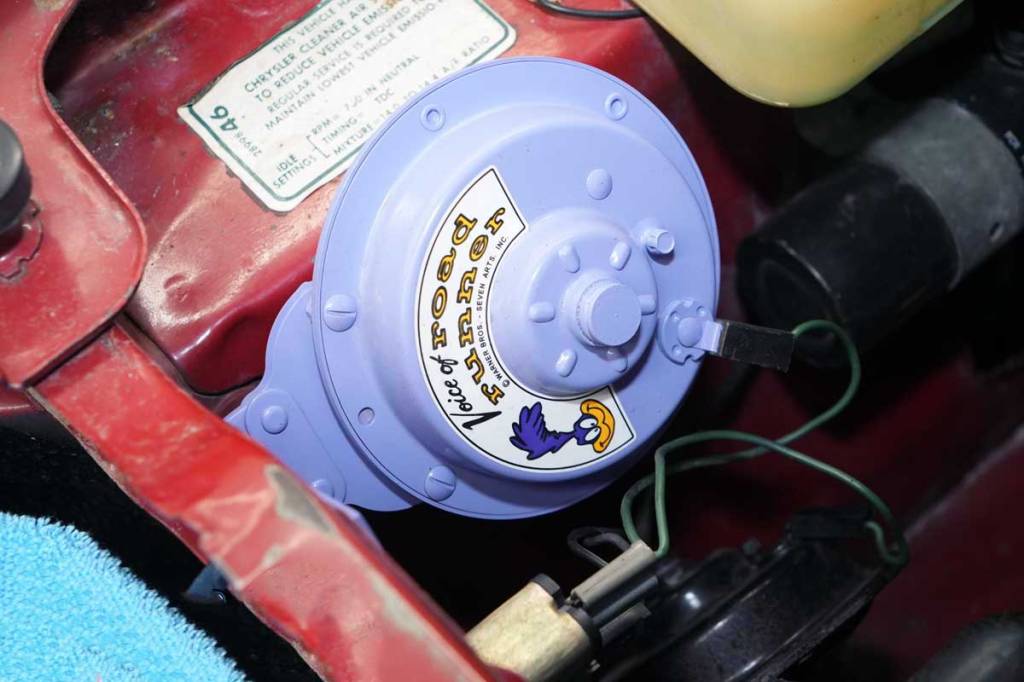
To make it stand out under the hood, Sparton painted the horn a bright, almost lavender purple. Hidden behind the grille on the passenger’s side radiator support, it was the only splash of whimsy in an otherwise purposeful engine bay. The horn was stamped “SPARTON BEEP BEEP” and carried part number 2822271. When you pressed the horn button, it did not honk; it grinned.
Even the debate over whether the sound should be written as “Beep-Beep” or “Meep-Meep” became part of the lore. Mel Blanc, the legendary voice actor behind the cartoon, reportedly conveyed that it was closer to “Meep-Meep.” Still, Plymouth stuck with “Beep-Beep” for clarity, as it looked better in an advertisement. And those ads were everywhere. Plymouth’s marketing team leaned into the humor, printing slogans like “It goes Beep-Beep!” next to the cartoon bird and a grinning 383 coupe smoking its tires. In subsequent years, the horn button wore a decal of the Road Runner’s head, complete with Warner Bros. copyright marks.
What started as a joke turned into an identity. The Road Runner’s sense of humor separated it from the competition. While Ford and Chevrolet were busy flexing muscle and menace, Plymouth gave its buyers something more, attitude with a wink. And buyers loved it. Plymouth had expected to sell twenty thousand cars that first year. They sold more than twice that. The vehicle that beeped at the world instead of roaring at it became the people’s muscle car.
Today, restorers prize original “Beep-Beep” horns. The purple finish, the distinct markings, and that unmistakable tone make them highly collectible. Reproduction units are available and sound close, but purists swear they can tell the difference; the originals have a quicker, brighter cadence that feels alive. Tap the button on a real ’68 Road Runner, and that sound bounces off the garage walls like it is 1968 all over again.
The beep-beep horn carried through the golden years, from the original 1968 cars through the high-wing 1970 Superbird and beyond. Even the later Volaré-based Road Runners of the mid-’70s kept the celebrated chirp. Today, reproduction horns find their way into everything from restored classics to modern Challengers, proof that a good laugh never goes out of style.
In an era when every manufacturer was trying to sound tougher, louder, and meaner, Plymouth found victory by sounding like nothing else on the road. The “Beep-Beep” was not just a horn; it was a declaration. It said speed could have a sense of humor, that performance did not need to be harsh, and that sometimes the quickest way to win people over is to make them smile. Fifty thousand dollars bought Plymouth the rights to a cartoon sound. What they really bought was immortality.
 Mopower Garage
Leave a comment