
Published by Christopher J. Holley | Mopar History & Tech | November 2025
In the world of precision engine building, “lining up the dots” might get you close, but “close” does not win dyno pull competitions or races. If you are serious about performance, finding true top dead center and degreeing your camshaft are as essential as torque specs and oil pressure. Here is why.
Finding True Top Dead Center
Every accurate measurement starts with a valid reference point, and for an engine, that is Top Dead Center (TDC) on the number one piston. The problem is that the timing mark on the balancer is not always accurate. Over the course of decades, parts swaps, timing cover changes, and manufacturing tolerances can cause the mark intended to represent TDC to be off by several degrees.
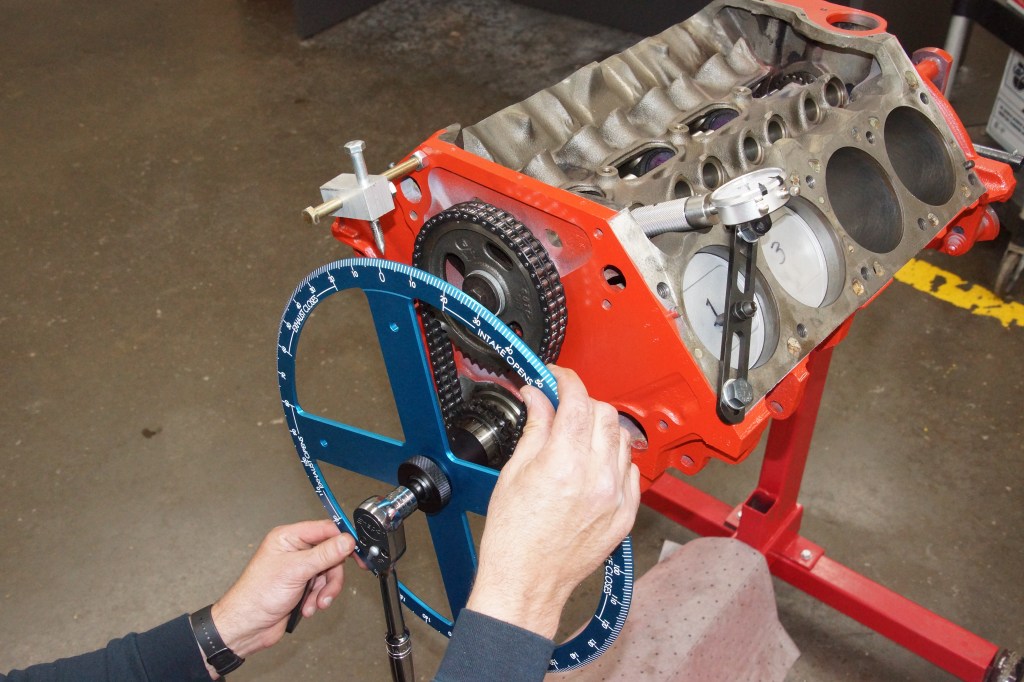
That is where a degree wheel and piston stop come into play. With the degree wheel bolted to the crank and a piston stop used in the number one cylinder, you can physically locate the exact point where the piston stops moving upward and begins to move down again. By measuring that point on both sides of TDC and splitting the difference, you establish true mechanical top dead center, the only reference point that really matters.
Once you have zeroed your degree wheel at that spot, every camshaft measurement you make will be accurate, no matter what the factory marks say.
Why You Do Not Just “Line Up the Dots”
With true TDC locked in, it is time to set the camshaft. The simple way is to line up the dots on the cam and crank sprockets. It looks right, and for a stock rebuild, it might be decent. But here is the problem: “lining up the dots” assumes everything else in the system is perfect, and in engine building, that is a dangerous assumption.
Cam grinders, timing sets, keyways, and even deck heights all carry tolerances. Stack a few slight variations together and your cam can end up four or five degrees advanced or retarded before you even know it. That is enough to shift the entire torque curve, kill cylinder pressure, or even cause piston-to-valve interference on a tight setup.
Degreeing the cam eliminates the guesswork. Using a dial indicator on a lifter and your degree wheel on the crank, you can chart the cam’s actual opening and closing points and verify that the intake centerline matches the cam card. If it does not, you can correct it using an adjustable timing set or offset bushings.
Blueprinting, Not Guessing
Finding true TDC and degreeing the camshaft is not about showing off; it is about control. It is the difference between assembling an engine and blueprinting one. When you know precisely where your piston and valves meet in time and space, you can predict how that engine will behave: where it will make torque, how it will idle, and what kind of power curve you will get.
“Lining up the dots” might be enough for the guy building a lawnmower. But for anyone who has ever looked at a dyno sheet and wanted to squeeze out every last horsepower, degreeing the cam is simply non-negotiable.
 Mopower Garage
Leave a comment