Published by Christopher J. Holley | Mopar History & Tech | November 2025
Engines do not just breathe, they resonate. Every time an exhaust valve opens, a shockwave of hot gas races down the header tube, followed by a rarefied pocket of low pressure. These traveling waves, or exhaust pulses, are the heartbeat of the engine’s breathing cycle. When properly harnessed, they can transform a basic exhaust system into a tuned symphony of power, torque, and crisp throttle response.
The Power of the Pulse
Each exhaust event starts with a high-pressure pulse as burnt gases exit the combustion chamber. As that pulse moves downstream, it is followed by a low-pressure wave that acts like a vacuum cleaner at the valve. This phenomenon, known as scavenging, helps pull the last traces of exhaust from the cylinder and even gives the incoming air-fuel charge a head start.
The trick lies in timing. By tailoring the pipe length and diameter, builders can tune the arrival of the low-pressure wave to coincide with valve overlap; the brief moment when both intake and exhaust valves are slightly open. If the wave reaches the valve at just the right instant, it helps the engine “breathe” more efficiently.
Longer primary tubes enhance scavenging at lower RPM, boosting torque and throttle response. Shorter tubes, on the other hand, favor higher-RPM power by tuning the pulses for faster wave travel. It is a balancing act that performance exhaust designers have refined for decades, from the Max Wedge’s long-tube manifolds to today’s equal-length headers.
The Art of the Merge
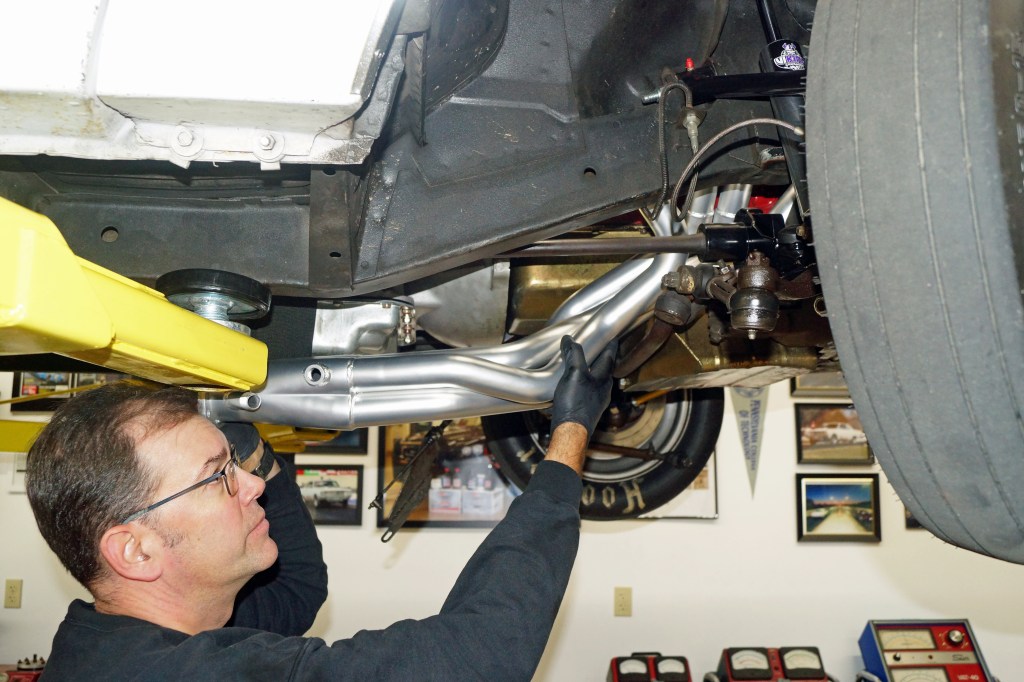
While exhaust pulses deliver the energy, bifurcation angles, and the geometry where tubes split or merge, control how smoothly that energy flows. The term refers to the angle formed at a junction, such as a header collector or Y-pipe. Get it right, and the gases merge like converging freeway lanes; get it wrong, and they collide, creating turbulence, backpressure, and lost power.
A well-designed collector uses a shallow merge angle, usually in the 10–20° range. This gentle transition maintains high flow velocity and preserves the individuality of each exhaust pulse, rather than allowing them to crash together and cancel each other out. The result is stronger scavenging, cleaner flow, and a more predictable torque curve.
Even the shape of the merge matters. A smooth, conical collector facilitates the transition of pressure waves from the narrow header tubes into the larger exhaust piping with minimal disruption. That is why high-end racing headers often feature hand-formed or CNC-machined collectors; they are tuned not only for flow but also for wave behavior.
Sound and Fury
Beyond power, these dynamics also shape the exhaust note. A well-tuned system not only performs better, but it also sounds healthier. Smooth bifurcation angles and consistent pulse timing produce a crisp, even tone, the kind of mechanical music that makes a big-block Hemi or small-block 340 instantly recognizable.
The Bottom Line
Exhaust design is more than just plumbing. It is a science of timing, geometry, and resonance. Exhaust pulses provide the rhythm; bifurcation angles conduct the flow. Together, they dictate how efficiently an engine breathes, how much torque it builds, and how good it sounds doing it.
The next time you hear the sharp bark of a tuned V8, remember, you are not just hearing combustion. You are hearing waves in motion, perfectly timed and harmonized through steel tubes and engineered angles. That is the hidden art behind horsepower.
 Mopower Garage
Leave a comment