Published by Christopher J. Holley | Mopar History & Tech | November 2025
Among the many quirks that have earned Chrysler products their loyal following, few components are as iconic—and occasionally misunderstood—as the ceramic ballast resistor mounted on the firewall. Whether the application is a 1960s big-block, a Slant Six commuter, or an early electronic-ignition setup, the ballast resistor played a crucial role in the way a Chrysler engine started, idled, and maintained coil health.
Although simple in appearance, this resistor represents a clever piece of engineering that allowed Chrysler to balance strong starting performance with long component life.
The Real Reason the Ballast Resistor Exists
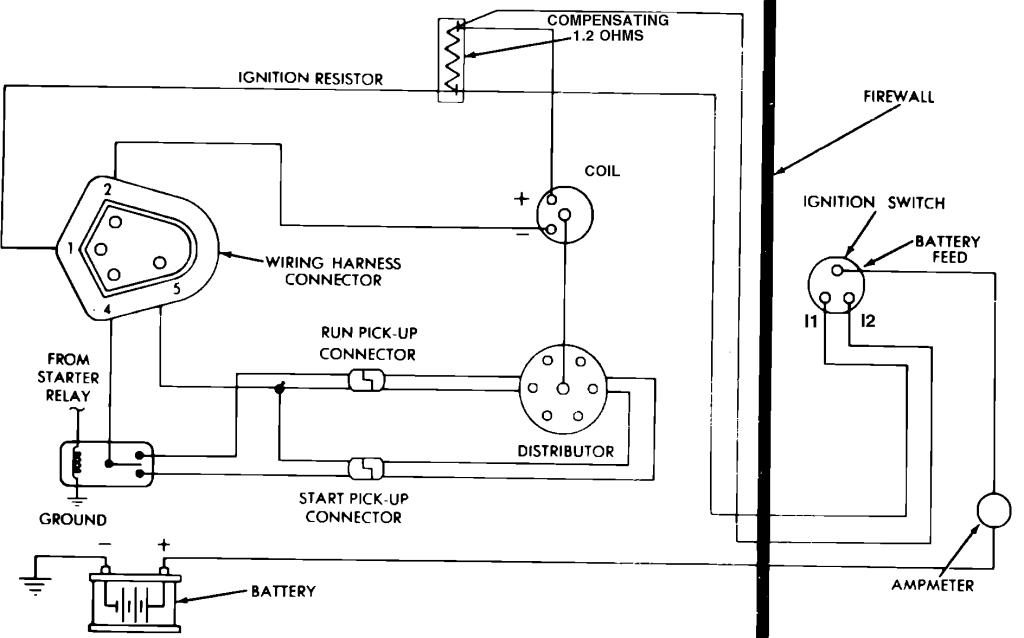
At the heart of any ignition system lies the coil, a device that transforms low battery voltage into the high voltage required to fire a spark plug. However, coils are sensitive to current. Feed a coil a full 13.5 to 14.2 volts continuously, as produced by a running alternator, and current will rise high enough to overheat the coil and damage points or early electronic modules. Chrysler engineers addressed this by installing a ballast resistor in series with the coil during normal operation.
Once the engine is running, the resistor drops voltage to the coil to approximately seven to nine volts. This reduction keeps the coil at a safe operating temperature, protects the ignition module, and ensures stable firing over long periods of driving.
A Smarter Start: Full Voltage During Cranking
The ballast resistor was never intended to reduce performance. In fact, it was designed to enhance it during the most demanding moment: starting. Heavy starter draw causes battery voltage to sag, sometimes dropping into the nine-volt range. If the coil were still operating through the resistor during cranking, available voltage could dip too low to produce a reliable spark.
Chrysler solved this with the IGN2 bypass circuit built into the starter relay. During cranking, full battery voltage is delivered directly to the coil, completely bypassing the resistor. As soon as the key returns to the RUN position, the system routes power back through the ballast to protect the coil. The result is excellent cold-start performance paired with long component life once the engine is running.
How To Test a Chrysler Ballast Resistor
Although robust, ballast resistors can fail, usually by opening internally. A failed resistor is one of the most recognizable Chrysler symptoms: the engine starts while cranking, then dies the instant the key returns to RUN. Fortunately, testing is straightforward and quick.
Resistance Test (Engine Off)
Factory specifications vary slightly, but most Chrysler single-section resistors measure between 0.3 and 1.5 ohms. Dual-section resistors, used on many electronic-ignition systems, include a low-ohm section (0.3 to 0.5 ohm) and a higher-value section (5.0 to 7.0 ohms).
Procedure:
- Disconnect the wires from the resistor.
- Use an ohmmeter to measure across each section.
- Compare the readings to specifications.
Any section reading open (OL) indicates failure.
Voltage Drop Test (Key On – RUN)
This test is fast, practical, and excellent for diagnosing intermittent concerns.
Procedure:
- With the key in RUN, measure voltage between battery positive and the coil positive terminal.
- A drop of approximately four to six volts indicates the resistor is working.
Zero volts at the coil indicates an open resistor, while full battery voltage on both sides suggests a shorted unit.
Cranking Bypass Verification (IGN2 Test)
Although not a resistor test, this step confirms proper operation of the bypass circuit.
Procedure:
- Place the meter on coil positive.
- Crank the engine.
- The meter should show approximately 10 to 12 volts during cranking.
Lower voltage indicates a failed IGN2 circuit, a common cause of “starts only when the key is released.”
Typical Failure Symptoms
Ballast resistor failures often present themselves in predictable ways:
- Engine starts during cranking but immediately stalls
- No spark in the RUN position
- Intermittent stalls followed by quick restarts
- Weak spark caused by a high-resistance dual-section ballast
These symptoms make the resistor a high-priority suspect in any Chrysler no-start or stall diagnosis.
A Small Component with Outsized Impact
The Chrysler ballast resistor may be a simple ceramic block, but it reflects a thoughtful approach to ignition design. By balancing strong starting energy with coil protection, Chrysler created a system that performed reliably for decades. Understanding how this component works—and how to test it—remains essential knowledge for technicians working on vintage Mopar vehicles today.
 Mopower Garage
Leave a comment