
Published by Christopher J. Holley | Mopar History & Tech | November 2025
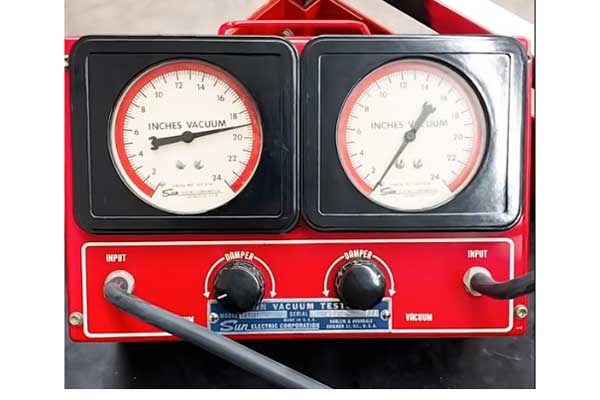
Vacuum has always been one of the most honest indicators of what an internal combustion engine is doing. Long before scan tools and data streams, technicians learned to diagnose engines by watching a simple vacuum gauge dance across its dial. When tuning or troubleshooting a carbureted Chrysler V8, few tools will provide more direct information than a dual vacuum gauge. By observing manifold vacuum and ported vacuum simultaneously, the technician gains a two-channel window into the engine’s mechanical condition, carburetor behavior, and ignition advance strategy.
Two Signals, Two Stories
Although both readings originate from the same engine, manifold vacuum and ported vacuum serve two very different purposes. Understanding the distinction is essential.
Manifold Vacuum
Manifold vacuum is taken from below the throttle plates, typically from the intake manifold or a full-vacuum nipple on the carburetor base. This is the vacuum source that reveals the engine’s internal health. A strong and steady reading at idle, often between 15 and 22 inHg on a stock camshaft, tells the technician that the rings are sealing, the valves are breathing correctly, and the ignition timing is within a reasonable range. A pulsing or low reading suggests leaks, improper adjustment, or mechanical wear.
Manifold vacuum drops sharply when the throttle opens, then recovers as the engine reaches a steady cruise. It is the classic indicator of load.
Ported Vacuum
Ported vacuum, also known as the vacuum-advance source, is tapped from a passage above the throttle plates. Unlike manifold vacuum, the ported source should show zero vacuum at idle. Only when the throttle opens slightly off idle should the port begin to see vacuum. This is the signal that activates the distributor’s vacuum advance mechanism during light-load conditions.
On a correctly adjusted carburetor, ported vacuum rises quickly as the vehicle transitions off idle and often approaches manifold vacuum during steady-state cruising. Under heavy load or wide-open throttle, the signal collapses, causing the vacuum advance to drop out so that ignition timing is controlled solely by mechanical advance.
What the Dual Gauge Reveals
Viewing both vacuum signals simultaneously provides a clearer picture than watching either one alone.
Idle Quality and Carburetor Setup
At idle, the manifold vacuum gauge should show a healthy, steady level. The ported vacuum gauge should rest at zero. If the ported gauge shows any vacuum at idle, the throttle plates are positioned too far open. This can occur because the idle speed screw has been over-adjusted or because the ignition timing is too retarded, forcing the plates open to maintain idle speed. In some cases, the idle circuit may be restricted, causing the technician to compensate by opening the plates further.
Off-Idle and Transition Behavior
As the throttle begins to open, the technician will see a natural crossover. Manifold vacuum begins to drop as ported vacuum comes alive. This transition reflects the point where the distributor begins to add vacuum advance, improving throttle response and part-throttle efficiency. An erratic or delayed rise in ported vacuum may indicate restrictions or issues in the carburetor’s transition circuits.
Cruise and Load Changes
During steady cruise, manifold vacuum stabilizes at a moderate level, while ported vacuum peaks. This is the moment when the distributor’s vacuum advance is fully engaged, adding significant ignition timing for cleaner combustion and improved fuel economy. A weak or inconsistent ported signal during cruise suggests that the vacuum passage or hose may be restricted, or that the vacuum advance unit is failing to respond.
Acceleration and Wide-Open Throttle
Under heavy acceleration, both vacuum levels collapse. The vacuum advance instantly disengages, leaving timing control to the mechanical advance mechanism inside the distributor. A dual gauge allows the technician to confirm that this transition occurs precisely when it should.
Common Issues Identified by Dual Vacuum Testing
Several drivability problems can be diagnosed quickly using this two-channel method.
- Vacuum advance failure: Strong ported vacuum under cruise with no increase in ignition timing indicates a failed diaphragm or an obstructed vacuum hose.
- Throttle plate misadjustment: Vacuum present at the ported source during idle points to excessive throttle opening or incorrect timing settings.
- Mechanical engine problems: Low or unstable manifold vacuum paired with a sluggish ported response often signals a deeper mechanical concern such as improper valve timing, vacuum leaks, or excessive camshaft overlap.
- Off-idle stumble: A delayed rise in ported vacuum suggests a problem in the carburetor’s transition slot behavior or the off-idle fuel circuit.
A Classic Tool for Modern Diagnostics
Although electronic tools dominate contemporary automotive diagnostics, the dual vacuum gauge remains a remarkably effective device for tuning and verifying carbureted engines. It allows the technician to see not only how the engine is breathing but also how the ignition system is reacting to changing load conditions. When used correctly, these two needles reveal an engine’s intent with remarkable clarity.
 Mopower Garage
Leave a comment