
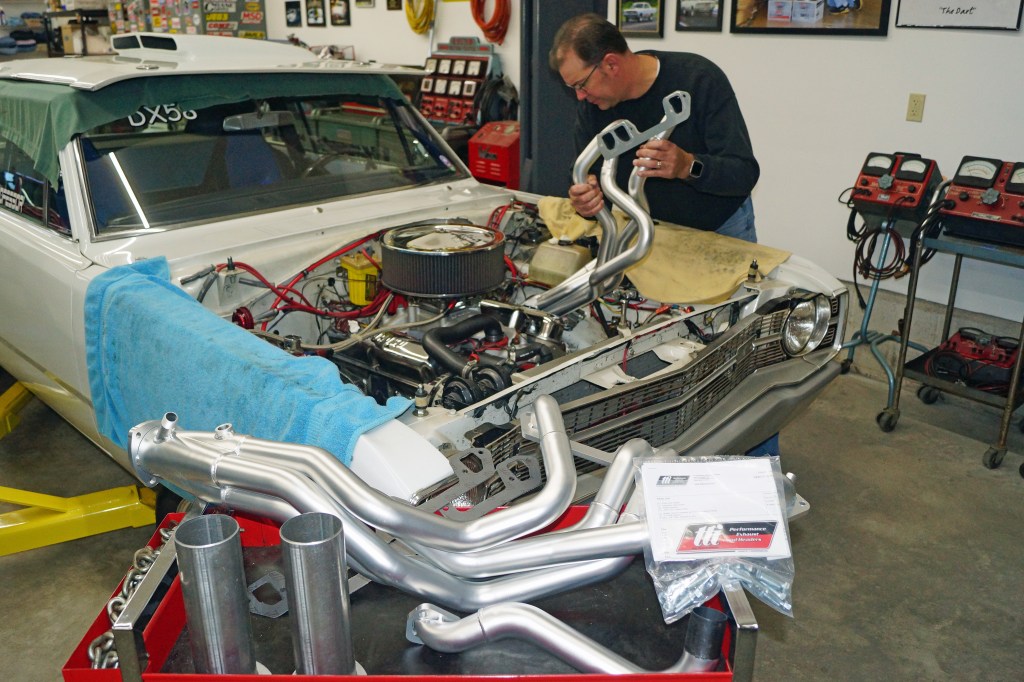
Published by Christopher J. Holley | Mopar History & Tech | December 2025
The following is a clear, practical explanation of the benefits of headers, stepped headers, merge collectors, and collector extension pipes, and how each one affects engine performance.
- Headers
What they are:
Headers replace the restrictive cast-iron exhaust manifold with individual, equal-length tubes that route exhaust from each cylinder to a collector.
Benefits
• Reduced backpressure: Freer exhaust flow improves engine breathing.
• Better scavenging: Improved pulse timing helps pull fresh air/fuel mixture into the cylinder.
• Increased horsepower & torque: Especially noticeable at mid–high RPM.
• More consistent cylinder flow: Equal-length tubes help cylinders make similar power.
Overall: Headers provide a baseline improvement to airflow efficiency and power.
- Stepped Headers
What they are:
Header tubes that increase in diameter in stages (for example: 1.625″ → 1.75″ → 1.875″) as they approach the collector.
Benefits
• Improved scavenging at low and mid RPM: The smaller first section increases gas velocity.
• Reduced reversion: The step acts as a barrier to pressure waves backing up into the cylinder.
• Better high-RPM flow: The larger downstream sections prevent choking at high engine speeds.
• Wider powerband: Compared to single-diameter headers, stepped headers broaden usable torque.
Overall: Stepped headers help balance low-end velocity with top-end flow.
- Merge Collectors
What they are:
A type of collector where the primary tubes converge smoothly, often with a formed “spike” or pyramid that encourages the exhaust pulses to blend rather than collide.
Benefits
• Better pulse energy retention: Smoother transitions reduce turbulence.
• Stronger scavenging: The merge spike focuses flow and increases exit velocity.
• Increased mid-range and high-RPM power: Particularly helpful on high-revving engines.
• Reduced pressure fluctuations: Cleaner pulse behavior improves cylinder filling consistency.
Overall: Merge collectors are a premium component that improve efficiency, horsepower, and torque, especially for performance or racing applications.
- Collector Extension Pipes
What they are:
Pipes attached after the collector, often 12–24 inches long, sometimes tunable in length. They affect the reflected pressure waves entering the primaries.
Benefits
• Fine-tuning of torque curve:
- Longer extensions boost low- and mid-range torque
- Shorter extensions enhance top-end power
- Improved scavenging timing: Proper length positions the returning rarefaction wave to help pull exhaust out of the cylinder at the right time.
- Stabilized exhaust pulses: Helps maintain gas velocity and pulse separation.
- Better overall cylinder filling: Correct wave tuning increases volumetric efficiency.
Overall: Collector extensions allow exact tuning of the engine’s torque characteristics.
Summary Table
| Component | Main Purpose | Key Benefits |
| Headers | Replace restrictive manifolds | More flow, better scavenging, more power |
| Stepped Headers | Increase tube diameter in stages | Better low-end velocity + top-end flow, reduced reversion |
| Merge Collectors | Smooth convergence of primaries | Stronger scavenging, higher RPM power, reduced turbulence |
| Collector Extensions | Tune reflected pressure waves | Adjusts torque curve, improved scavenging timing |
Part 1 — How These Components Interact as a System
Exhaust performance is not about individual parts. It is about managing pressure waves and gas velocity from the exhaust valve all the way to the tailpipe.
Think of the exhaust as a timed sequence of pressure pulses traveling down a pipe system, these pulses, not just the gases themselves, determine how efficiently cylinders empty and refill.
Here is how each part works together:
1. Headers (Primaries)
Role in the system:
• Set the initial velocity of exhaust flow.
• Establish the timing between pulses from each cylinder.
• Create the first wave reflections.
Interaction:
If the primary tubes are too big → velocity drops → scavenging is weak.
If too small → high RPM flow chokes.
Correctly sized primaries keep pulses sharp and fast, which is essential for the parts downstream (collector and extensions) to work.
2. Stepped Headers
Role in the system:
• Smooth the transition from high-velocity, high-pressure gas near the exhaust port to lower pressure as it travels downstream.
• Prevent reversion, which is the backward movement of exhaust gas or pressure waves.
Interaction:
• The first (smallest) diameter section keeps velocity high at the start.
• Each “step” slows reversion and prepares pulses for cleaner entry into the collector.
• The stepped sections shape the pressure waves so the merge collector can efficiently blend them.
Important: Stepped headers do not increase peak power by themselves, they improve the quality of pulse flow, which boosts the system’s overall wave timing.
3. Merge Collectors
Role in the system:
• Blend the separate pulses from each header tube into a strong, focused, high-velocity stream.
• Create a powerful rarefaction (negative pressure) wave that travels back up the primaries to aid scavenging.
Interaction:
• If primaries and steps feed the collector well, the merge spike shapes pulses into a single coherent flow.
• Cleaner merging means more effective pulse extraction from the next firing cylinder.
• The negative wave generated by the collector is what collector extensions use for tuning.
Think of the merge collector as the “pulse amplifier”: it increases the effectiveness of pulses created upstream.
4. Collector Extensions
Role in the system:
• Tune the timing of the returning negative wave produced by the collector.
This is wave tuning, like how a tuned intake runner works.
Interaction:
• If the collector extension is the right length, the negative wave returns to the exhaust valve exactly as the valve is opening, helping pull gases out.
• If it is too short or too long, the returning wave arrives at the wrong time and may hurt torque.
This is why collector extensions allow shaping the torque curve:
• Longer extensions → return wave arrives earlier → stronger low/mid torque
• Shorter extensions → return wave arrives later → improved high RPM power
Together, headers + steps + merge collector + extension form a wave-tuned exhaust system.
Part 2 — A Deeper Look at Exhaust Pulse Flow
Let us break it into the actual physics:
1. Exhaust is not a steady stream
The flow is a series of high-pressure pulses caused by combustion.
Each pulse has:
• A high-pressure front (the blast of exhaust gas)
• A low-pressure region behind it
• A reflected wave which can be positive or negative
The goal is to manipulate these pulses to reduce cylinder pressure at the moment the exhaust valve opens.
2. Scavenging (the heart of pulse tuning)
Scavenging = using momentum and pressure waves to help pull exhaust out of the cylinder AND improve cylinder filling.
How it works:
- A pulse leaves the cylinder → creates a traveling high-pressure wave.
- Behind it forms a negative pressure wave.
- When this negative wave arrives back at the exhaust valve while it is open, it:
- pulls out residual gas
- helps draw the intake charge in (during overlap)
This increases volumetric efficiency, which is free horsepower.
3. Reflection of waves
Every change in pipe diameter or direction acts like a mirror for pressure waves.
• Entering a larger diameter → creates a negative reflection
• Entering a smaller diameter → creates a positive reflection
• A merge collector produces both types in a controlled pattern
This is why stepped headers are so effective:
Each step creates a controlled negative reflection to fight reversion.
4. Pulse timing is everything
The goal is to time the negative wave, so it arrives when the exhaust valve opens.
• Too early → pulse already passed → weak scavenging
• Too late → valve is closing → little effect
• Wrong RPM range → torque curve suffers
This is why collector extensions can dramatically reshape the torque curve, because they control when the negative wave returns.
Putting it All Together
Here is the system flow:
Cylinder → Primary tube → Stepped sections → Merge collector → Extension
And here is what each part does in sequence:
- Primary tubes: Create strong pulses + high velocity
- Steps: Maintain velocity + produce controlled reflections
- Merge collector: Combine pulses cleanly + generate strong negative wave
- Collector extension: Tune when the wave returns to the valve
This creates a tuned exhaust system where the physical shape of the pipes matches the timing of the engine’s camshaft and firing order.
Final Summary
Headers start the pulse.
Stepped headers shape the pulse.
Merge collectors strengthen and focus the pulse.
Collector extensions time the pulse.
When all four work together, you get:
• Stronger low-end torque
• Higher peak horsepower
• Wider usable powerband
• Better throttle response
• More consistent cylinder-to-cylinder airflow
 Mopower Garage
Leave a comment