
Published by Christopher J. Holley | Mopar History & Tech | December 2025
For decades, Chrysler vehicles carried a small but notorious quirk that continues to surprise restorers, racers, and tire technicians alike: left-hand threaded lug nuts on the driver’s side wheels. To modern eyes, the practice appears unnecessary, confusing, and even counterproductive. However, when viewed through the lens of early automotive engineering, Chrysler’s decision was neither arbitrary nor foolish. It was a calculated response to the realities of wheel design, metallurgy, and service conditions of the era.
An Engineering Solution to a Real Problem
In the early and mid-twentieth century, automotive wheels and hubs differed significantly from what enthusiasts are accustomed to today. Steel wheels were relatively thin and flexible, wheel studs were often of modest strength, and lug nuts were torqued to lower and less consistent specifications. Under these conditions, engineers were concerned about self-loosening, a phenomenon caused by cyclic loading during acceleration and braking.
Chrysler engineers believed that wheel rotation could impart a loosening force on conventional right-hand threaded fasteners when installed on the left side of the vehicle. By reversing the thread direction on that side, the natural forward rotation of the wheel would instead apply a tightening tendency. In theory, this approach reduced the likelihood of lug nuts backing off over time.
This concept was not unique to Chrysler. Similar logic had long been applied in railroads, heavy machinery, and industrial equipment, where rotational forces were known to influence fastener retention. Several other manufacturers, including Buick, Oldsmobile, Pontiac, and Studebaker, experimented with left-hand wheel fasteners during the same period.
Why Chrysler Stayed the Course
While most manufacturers eventually abandoned the practice, Chrysler retained left-hand threaded lug nuts longer than nearly anyone else. The reasons were rooted as much in corporate culture as in engineering.
Chrysler traditionally favored conservative, durability-focused design decisions. The company produced large numbers of fleet vehicles, including police cars, taxis, and heavy-duty sedans, where reliability under hard use was paramount. From that perspective, a solution that theoretically reduced wheel fastener loosening was worth retaining.
Additionally, institutional inertia played a role. Service manuals, dealership training programs, parts inventories, and tooling had all been standardized around the left-hand thread system. Changing course would have required retraining mechanics and updating procedures nationwide, all to address a problem that Chrysler engineers believed had already been solved.
Why the Practice Became Obsolete
By the late 1960s, advances in wheel and fastener technology rendered the original concern largely irrelevant. Modern conical-seat lug nuts provided superior centering and clamping force. Improved metallurgy allowed for stronger studs and more consistent torque values. Wheel designs became stiffer, and radial tires altered the way loads were transmitted through the hub.
At the same time, the disadvantages of left-hand threads became increasingly apparent. Tire shops unfamiliar with the system frequently stripped studs or snapped lug nuts. Owners attempting roadside repairs encountered unnecessary frustration. The theoretical benefit of rotational tightening no longer justified the very real service complications.
As a result, Chrysler phased out left-hand threaded lug nuts on most passenger cars between 1969 and 1971, with trucks and fleet vehicles following shortly thereafter.
A Detail That Still Matters Today
For restorers and racers working with classic Mopars, this detail remains critically important. Many original hubs, drums, and axles still retain left-hand threaded studs on the driver’s side. Mixing left-hand and right-hand components can lead to improper torque, damaged threads, or wheel failure.
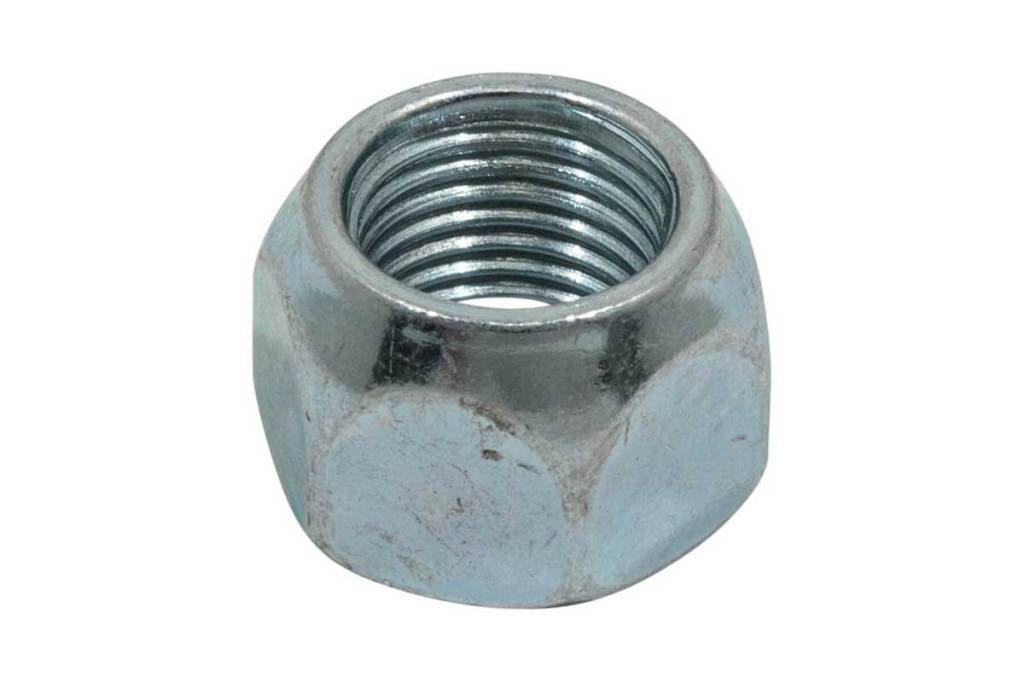
Original Chrysler studs were typically marked with an “L” stamped into the end, while left-hand lug nuts often featured identifying grooves or notches. Preserving or correctly converting these systems requires careful attention, particularly on high-performance or competition vehicles.
The Legacy of Conservative Engineering
Chrysler’s use of left-hand threaded lug nuts stands as a reminder of how engineering decisions are shaped by the technology and assumptions of their time. What began as a logical, safety-oriented solution eventually became an anachronism, outpaced by improvements in materials and design.
It is a classic case of sound engineering aging into poor user experience, and a testament to Chrysler’s reputation for durability-focused thinking, even when it meant holding onto ideas longer than the rest of the industry.
In the world of classic Mopars, understanding details like this is not just trivia. It is part of respecting the machinery, the history, and the mindset that produced it.
 Mopower Garage
Leave a comment