Published by Christopher J. Holley | Mopar History & Tech | January 2026
1. Overall Philosophy
- The front and rear work together: The front controls weight transfer, and the rear controls tire loading and axle rotation.
- Shocks control the speed of movement, and limiters control distance of movement.
- Bias-ply tires need progressive, predictable motion: overshoot causes spin or bounce.
- Front geometry and TOOT / camber must be controlled to minimize camber change on launch.
- Rear geometry and instant center (IC) position must be controlled to maximize traction without oscillation.
Rule of Thumb:
“Allow the car to move naturally, then control it with damping.”
2. Front End Setup
Front suspension: Short/Long arm (SLA) with torsion bars.
Goal:
- Smooth front rise for weight transfer
- Limit camber change during launch
- Controlled nose drop after the hit
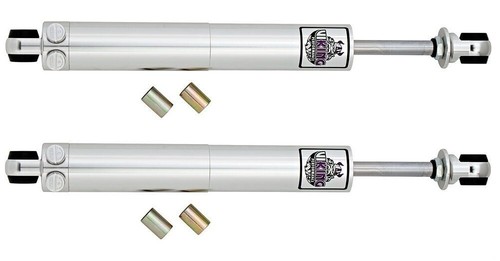
Front Shocks (Viking dual-adjustable)
| Direction | Setting (Clicks from soft) | Purpose |
| Rebound / Extension | 4–6 | Allow the front to rise smoothly and transfer weight to the rear tires |
| Compression / Bump | 12–14 | Control nose drop, prevent overshoot, stabilize steering |
Front Camber and TOOT Notes:
- Static camber: –0.25° to –0.75° (negative to offset front rise)
- TOOT: minimal (0–1°) for drag stability
- Positive caster: +5° to +7° to aid self-centering
Travel Limiter:
- Target front rise: approximately 2–3 inches
- Controls excessive camber gain
Teaching note:
The front is “the throttle control for geometry”: rise allows the rear to load, limiter plus compression controls camber and steering.
3. Rear End Setup
Rear suspension: Mopar leaf springs with CalTrac or torque-arm style setup.
Goal:
- Load tires consistently
- Maximize traction
- Control axle rotation (instant center management)
- Prevent wheel hop
IC Consideration
- IC above neutral line (common in Dart / A-body)
- The rear wants to rise on launch, and the nose comes up
- Solution: rear extension soft, rear compression stiff
- IC below neutral line
- The rear wants to squat on launch
- Would require the opposite adjustments (not the case here)
Rear Shocks (Viking dual-adjustable)
| Direction | Setting (Clicks from soft) | Purpose |
| Rebound / Extension | 4–6 | Allow the rear to rise and load the tires properly |
| Compression / Bump | 12–14 | Control settling, prevent oscillation, maintain predictable pinion return |
CalTrac / Preload Notes:
- Slight preload on driver side to load rear tires evenly
- Passenger side neutral
- Preload is not the primary solution for IC issues or shock damping
4. Hot Versus Cold Track Adjustments
Hot Track (grippy surface):
- Rear compression: tighten 1–2 clicks to control overshoot
- Rear rebound: tighten 1 click to prevent bounce
- Front rebound: tighten 1 click if the nose rises too fast
- Front compression: tighten 1 click only if steering wanders
Cold Track (slick / low VHT surface):
- Rear compression: loosen 1–2 clicks to allow tire to wrinkle
- Rear rebound: loosen 1 click to increase rise and weight transfer
- Front rebound: loosen 1 click to increase weight transfer
- Front compression: usually leave unchanged
Rule: Always adjust the rear first, then the front. Make 1–2 click changes maximum per pass.
5. Bias-Ply Tire Notes
- Rear bias-ply tires are sensitive to sudden motion; shocks must smooth movement
- Front bias-ply tires tolerate slight rise; use a limiter to control camber
- Make small incremental changes on shocks; avoid large swings
6. Summary – Baseline Track Settings
Front:
- Rebound: 5 clicks
- Compression: 13 clicks
- Static camber: –0.25° to –0.75°
- TOOT: 0–1°
- Front rise: 2–3 inches
- Caster: +5–7°
Rear:
- Rebound: 5 clicks
- Compression: 13 clicks
- CalTrac preload: slight driver-side, neutral passenger
- IC above neutral line
7. Trackside Tuning Order
- Rear compression → traction and launch
- Rear rebound → axle control and settle
- Front rebound → weight transfer and nose rise
- Front compression → nose drop and steering stability
Never adjust more than two items per pass.
8. One-Line Philosophy for Students
“Front: allow it to rise, control the drop. Rear: allow it to load, control the settle. Shocks make the car predictable; tires make the car fast.”
 Mopower Garage
Leave a comment