
Text and Photos by Chris Holley
March 2017
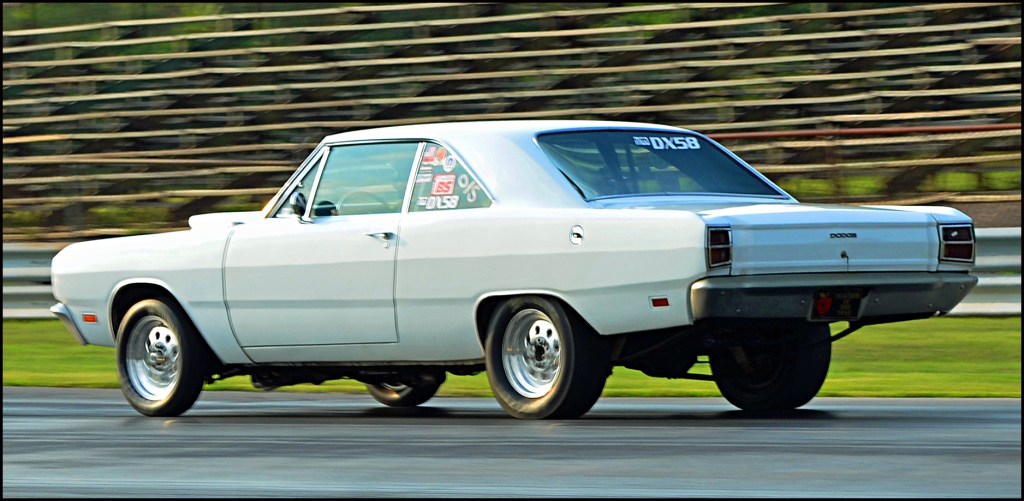
The assessment of the manifolds and carburetors spacers proved to be a good series of tests to fine tune the 340 combination. There is horsepower to be found in testing parts in a systematic fashion. Do not get sucked into the hype about a part or the “flavor of the week”. Test, test, and test until you find a part that works for you. This photo is just before the 1/8-mile marker with the 340 at full song breaking into the 7.0s in the 1/8-mile for the first time with the open plenum carburetor spacer. The open spacer proved to be the best spacer for this 340, your results may vary. (Photographer – George Holley)
When it comes to a drag car, there is an old adage that in the constant pursuit of a quicker elapsed time (ET), a faster mph, or a more consistent part that ultimately brings about a win light, evaluating parts never seems to end. In our quest to continually improve, MoparMax selected a new Edelbrock Performer RPM Air-Gap intake manifold to track test with three different 1-inch carburetor spacers on a warmed over 340 in a 1969 Dodge Dart.
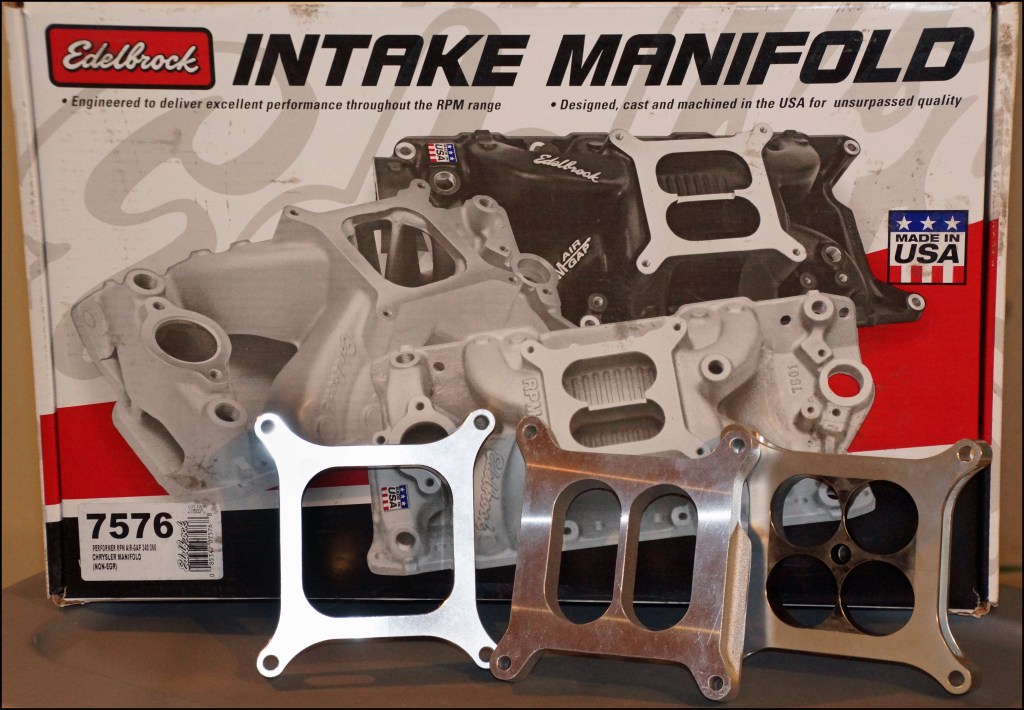
Edelbrock’s Performer RPM Air-Gap (part no. ELD-7576) was the focus of the testing on a modified 340 engine. Three 1-inch carburetor spacers were tested in conjunction with the Performer RPM Air-Gap. The spacers are a CSR tapered 4-hole spacer, a CSR open plenum spacer, and an Edelbrock divided plenum spacer.
The testing would be limited to only 1-inch maximum spacer thicknesses due to concerns of restricted under hood clearance of the fiberglass six-pack hood scoop. Two of the three spacers are CSR units. One of the CSR spacers is a tapered 4-hole spacer, and the second is an open plenum spacer. The third spacer to be tested is an Edelbrock divided plenum spacer.
The current engine configuration has an Edelbrock Torker II manifold with the CSR tapered 1-inch 4-hole carburetor spacer. The manifold has been on the engine for over a decade, and it has performed admirably during those years. The performance has been excellent with consistent 60’ times in the 1.52-1.55 second span with mid-to-high 11.40s in the quarter mile in the 114-mph range in a ‘69 Dodge Dart.
The current combination (setup of the engine, transmission, rear end, weight, etc.) of an Edelbrock Torker II manifold and a CSR tapered four-hole 1-inch carb spacer has resulted in consistent 60’ times in the 1.52-1.55 second range with mid-to-high 11.40s in the quarter mile in the 114-mph neighborhood. The current setup has produced an all-time best ET of an 11.358 at 117.17 mph with a 1.500 second 60’ time was clocked at Numidia Dragway (Numidia, PA). The plan for the 2017 season is to run a full season of heads-up 11.50-second index class races at Atco, Englishtown, and Maple Grove drag strips, and during the warmer months, the ETs tend to drop off positioning the current setup dangerously close to not being able to cover the 11.50 index. The concern of not covering the index is the reason for the change from the single-plane Torker II to the divided runner dual-plane Performer RPM Air-Gap manifold. The belief is that the RPM manifold will provide additional low- and mid-range torque helping to propel the Dart down the track a few hundreds to a tenth of a second quicker in the quarter mile thus adding some cushion to compensate for the dog days of summer.
The testing of the manifolds and spacers would occur over back-to-back weekends at Beaver Springs Dragway (Beaver Springs, PA). The first weekend would establish the baseline of the 340’s current setup of the Torker II manifold, the CSR tapered 4-hole spacer, and the optimized Holley carburetor. The next weekend would be the testing of the RPM Air-Gap manifold along with the three carb spacers, and jetting adjustments of the Holley carburetor.
Engine and Car
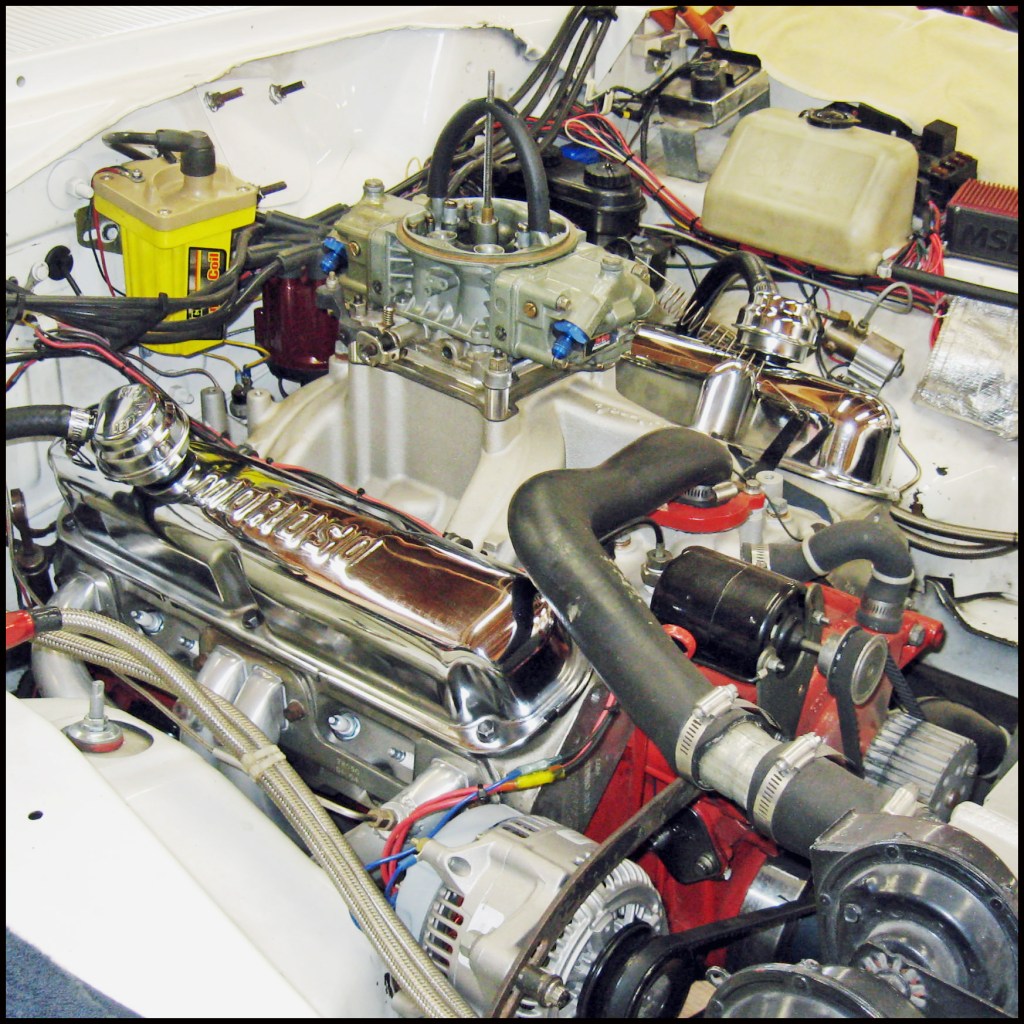
The 340 is fed via an annular discharge 830 cfm Holley four barrel. The carburetor has been optimized for the current combination with 84 jets in the primaries and 86 jets in the secondaries. The 50-cc accelerator pump pushes fuel to the .035” primary discharge nozzle squirter. The secondary discharge nozzle is also a .035” squirter. The 340 with the Torker II manifold and the tapered 4-hole spacer proved a solid baseline elapsed time (ET) of 11.374 at 114.94 mph. The 340 pulled the Dart to a 1.503 second 60’ time.
The 340 is a .040” over ’68 block with a ’68 stock forged steel crankshaft that swings Scat H-beam rods connected to factory replacement forged Speed Pro pistons and pins. The camshaft is a 26 year-old solid-lifter Direct Connection Purple Shaft with a .557” lift and an advertised 296 degrees of duration. A pair of gasket-matched Edelbrock aluminum cylinder heads top the block and Dick Landy prepped 1.5:1 roller rockers actuate the valves while oscillating on their respective hardened rocker shafts. For the baseline testing, the beforehand mentioned gasket-matched Edelbrock Torker II manifold rests on the heads and a 1-inch CSR tapered 4-hole spacer coupled with an annular discharge Holley 830 carburetor sits atop the engine.
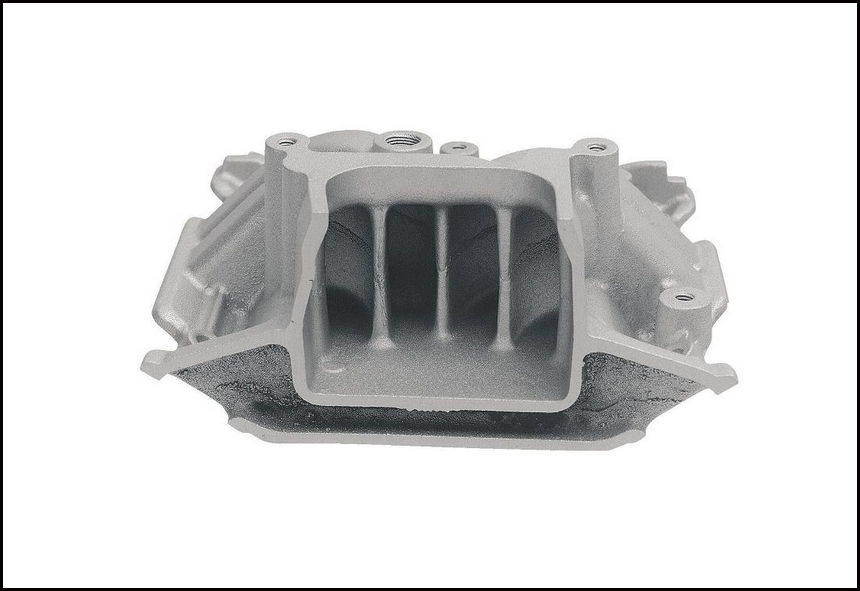
Edelbrock’s Torker II (part no. EDL-5076) features a low-rise, single-plane casting that is designed to maximize the top-end horsepower without disturbing the mid-range power. The intake is designed to minimize the turns of the intake runners, thus allowing the air-fuel charge a nearly straight shot from the carburetor to the intake valves. This manifold is designed to make power from 2,500 to 6,500 rpm. (Edelbrock photo)
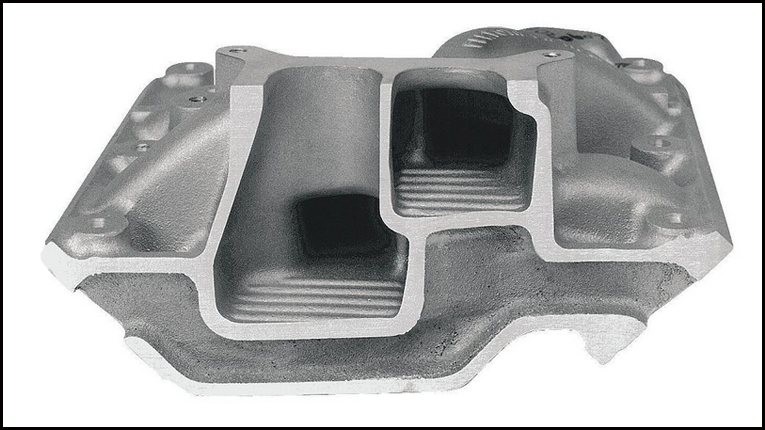
Edelbrock’s Performer RPM Air-Gap (part no. EDL-7576) is a dual-plane 180-degree design. This is a manifold design in which a primary and a secondary from the carburetor feed four of the eight cylinders (1-4-6-7 or 8-3-5-2) 180-degrees apart, which provides a more stable idle due to no overlap induction cycles. The RPM Air-Gap has an open-air space between the runners and the lifter valley, which reduces the amount of heat transferred from the engine into the manifold. A great disadvantage of a dual-plane intake can be the meandering runner design and the direction changes the air-fuel charge must make to reach the intake valve. The RPM Air-Gap is designed to make power from 1,500 to 6,500 rpm. (Edelbrock photo)
The engine breathes through a 14” x 5” K&N air filter, and the spent gasses exit the engine via a pair of Hooker Competition headers with 1 5/8” primaries flowing into 3” collectors with 6-inch extensions. The 340 is secured in the engine bay of the Dart via solid motor mounts. A foot-braked reverse-manual Torqueflite 904 automatic transmission with a standard gear set (1st 2.45:1, 2nd 1.45:1, and 3rd 1:1) backs the 340. The crankshaft is coupled to the transmission via a PTC 9 ½” torque converter with a flash stall speed of 5200 RPM. A Denny’s driveshaft spins a spool packed with 4.10:1 gears housed in an 8 ¾” rear end suspended on mono-leaf springs aided by Cal-Trac bars.
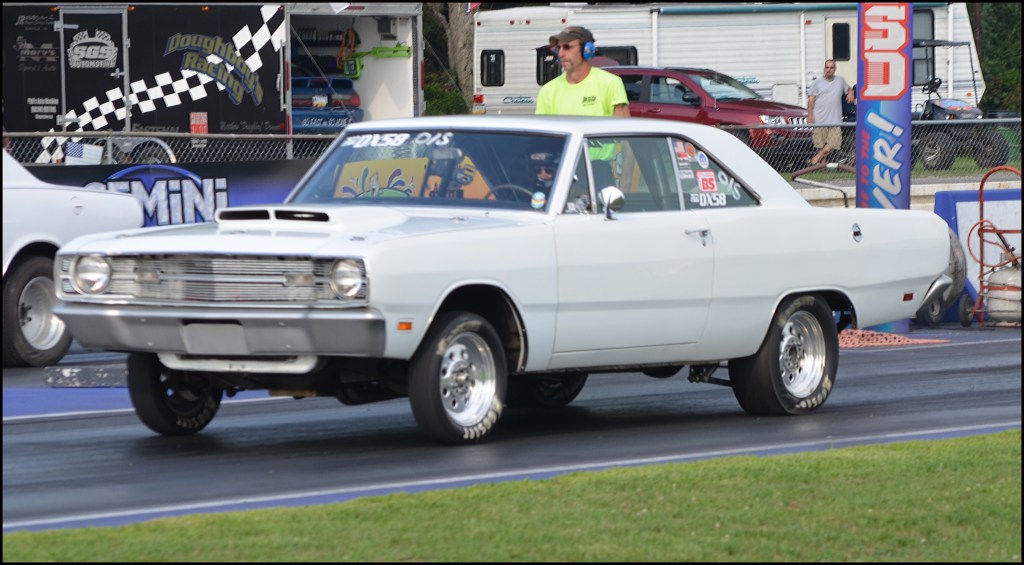
The Dart with the driver weights just over 3070 lbs. The 340 leaves the starting line at 3500 rpm, and it pulls through the speed traps at about 6500 rpm. This is one of the Edelbrock carb spacer runs, and the front tires unfortunately did not leave the track as they had on the previous CSR carb spacer tests. (George Holley photo)
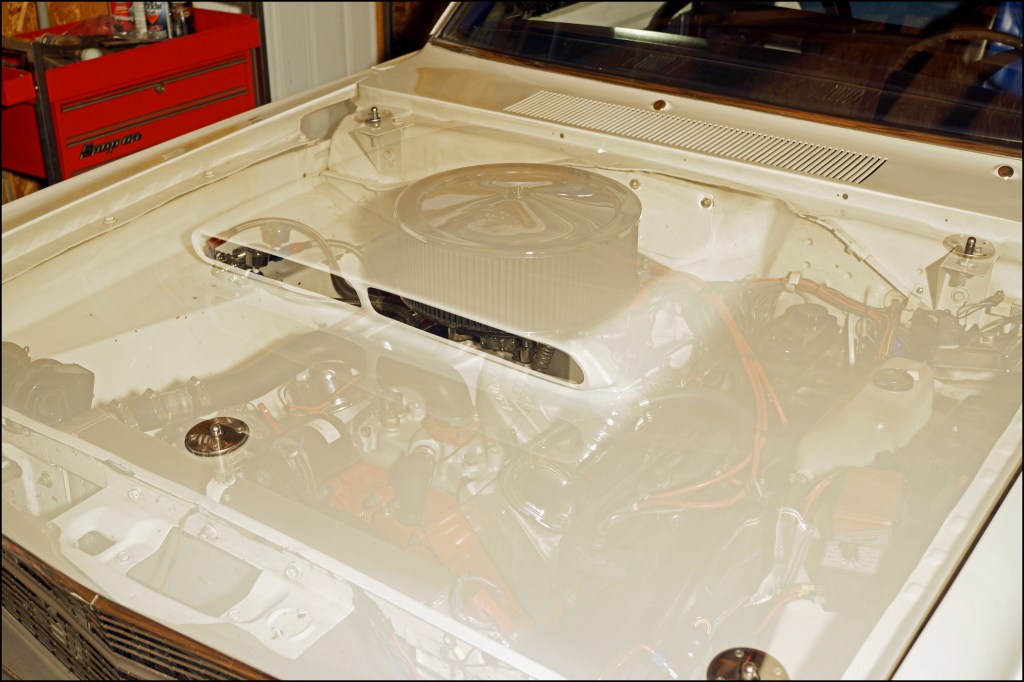
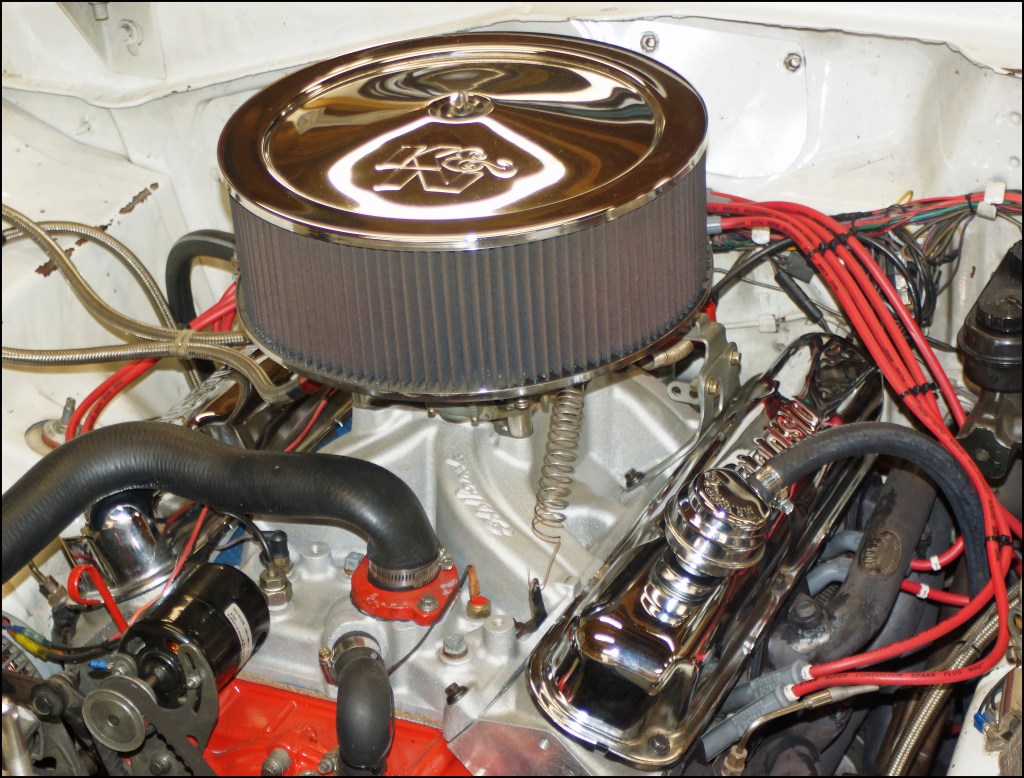
The 340 is nestled into the ‘69 Dart’s engine bay. The 14” x 5” K&N air filter housing fits up inside the fiberglass six-pack hood scoop. With the air filter housing in place, the under hood clearance is limited, so only 1-inch spacers would be evaluated. If there had been addition under hood clearance, thicker spacers could have been tested. Manufacturers can manufacturer spacers from 1/8” to 2” or more if desired for a specific application.
The Dart, with the author driving, has won multiple track championships at Beaver Springs Dragway in the outlaw pro-dial (heads-up “run what you brung” bracket format) class.
Intakes and the Reasons for Carburetor Spacers
The Edelbrock Torker II (part no. EDL-5076) features a low-rise, single-plane casting that is designed to maximize the top-end horsepower without disturbing the mid-range power. The intake is designed to minimize the turns of the intake runners, thus allowing the air-fuel charge a nearly straight shot from the carburetor to the intake valves. This manifold is designed to make power from 2,500 to 6,500 rpm. Although the Torker II has worked very well on the 340 for more than a decade, Edelbrock’s Performer RPM Air-Gap (part no. EDL-7576) appears to have latent potential that the 340 may be able to tap. The RPM Air-Gap provides an open-air space between the runners and the lifter valley, which reduces the amount of heat transferred from the engine into the manifold. A cooler intake means a denser air-fuel charge resulting in more power. The manifold is a dual-plane casting that provides excellent throttle response. The 180-degree design, a manifold design in which a primary and a secondary from the carburetor feed four of the eight cylinders (1-4-6-7 or 8-3-5-2) 180-degrees apart, provides a more stable idle due to no overlap induction cycles. A great disadvantage of a dual-plane intake can be the meandering runner design and the direction changes the air-fuel charge must make to reach the intake valve. The RPM Air-Gap is designed to make power from 1,500 to 6,500 rpm.
The use of a carburetor spacer provides a two-fold benefit. One, the intake plenum volume is increased by lengthening the plenum height, and two, moving the carburetor higher on the manifold increases the distance between the carburetor and the manifold floor providing a less abrupt turn for the air-fuel charge from the carburetor to the intake valve. A smoother transition will allow the fuel to remain suspended in the air rather than slamming into the manifold’s floor and puddling within the plenum. A more homogeneous air-fuel charge will always benefit the performance of the engine.
Carb spacers come in several different configurations to meet the specific performance needs of every engine permutation. The carb spacers can be tapered four-hole designs, or they can be non-tapered four-hole designs. The four-hole spacer design usually helps pick up the low-end torque, throttle response, and helps to reduce reversion while resulting in a small loss of power at high rpm. Another carb spacer design is an open plenum spacer design. The open plenum spacer usually helps the midrange torque and the upper rpm power while sacrificing low-end torque and potentially instigating some reversion concerns depending upon the camshaft selection. A divided plenum spacer will help midrange torque and a small amount of upper rpm horsepower because of the extra plenum volume. The “off the shelf” spacers can be found in ½-inch, 1-inch, and 2-inch thicknesses depending upon the need. If there is a specific spacer need, quality manufacturers can produce spacers as thin as an 1/8-inch to fine-tune a specific application. Depending upon the spacer’s thickness and construction material, an added benefit of a spacer is the ability to isolate heat from reaching the carburetor’s baseplate reducing problems with unwanted fuel vaporizing concerns.
So how does one know what spacer is for their engine? With the complexities of different designs, different thicknesses, and different construction materials, the only correct answer is to test the carb spacers. Test while keeping meticulous notes about as many parameters as you can. Develop a testing procedure that is highly effective and easily repeatable as each spacer (or component) is tested. Make sure to evaluate only one change at a time. Do not fall into the habit of trying to make two or more changes at a time in order to save some time or money (dyno time can be expensive). Multiple component changes at one time will make it impossible to evaluate which components were successful and which ones were not. Perform several runs (or dyno pulls) of the spacer under the same conditions to evaluate the overall performance before a change is made. A single test of a spacer will not provide a true indication of the performance. It is necessary to have access to accurate weather data, and the use of a personal weather station is the best source of real time information. The weatherman lies to you by trying to normalize the information provided. Guessing at the weather conditions, track conditions, wind direction will provide skewed data. You are wasting your time and money without accurate data. If an out of the box carb spacer works with your engine’s camshaft selection that is a fantastic value, but if the spacer does not work well with the engine, do not condemn the spacer. A spacer that works great in certain weather conditions may suffer when the temperature or humidity moves too far one way or another. A previously underperforming spacer may shine with a change in the weather temperature. Take time to test under various weather conditions, and always keep well-written notes, so you have something to which to refer in the future.
Baseline Testing
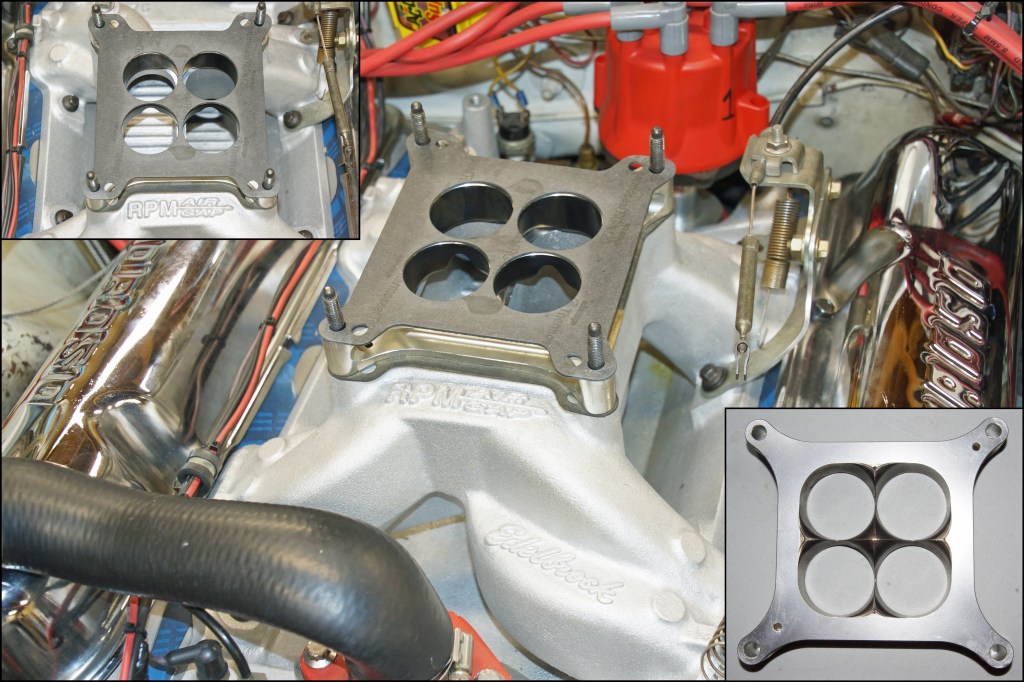
The first carburetor spacer to test was the CSR tapered 1-inch 4-hole spacer that had been previously used with the Torquer II manifold. The upper left inset photo illustrates the placement of the spacer over the RPM Air-Gap dual-plane manifold. The lower right inset photo illustrates the 4-hole spacer (upside down) to show the taper of the four holes. This combination resulted in a best 60’ of 1.544 seconds, and ET of 11.359 at 116.38 mph.
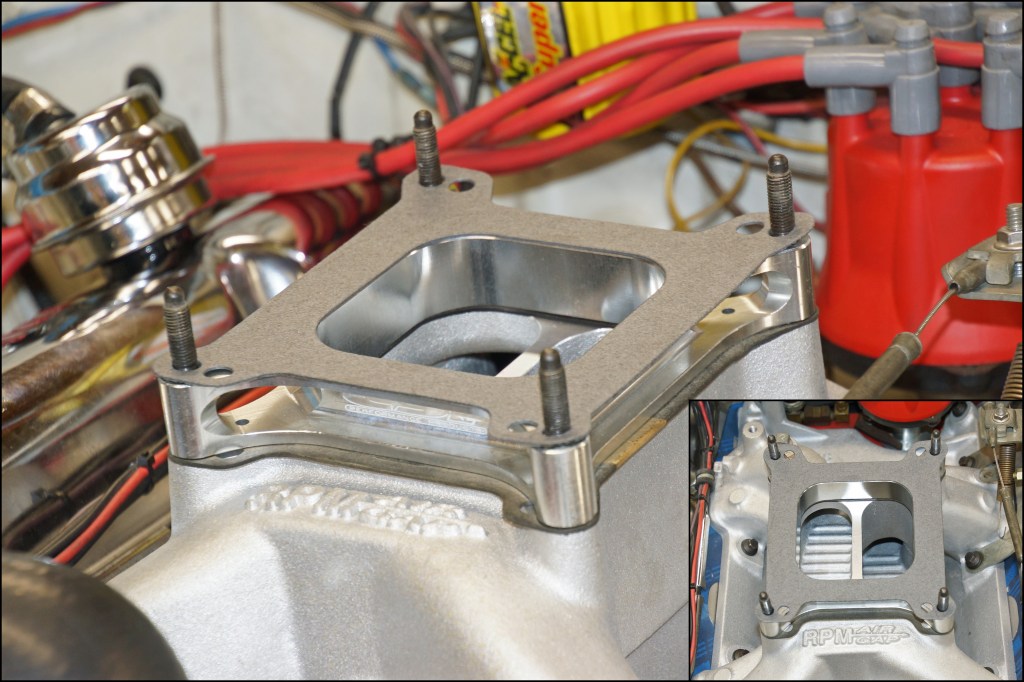
The next spacer to test was the CSR open plenum carburetor spacer. The inset photo shows the alignment of the spacer and the divided plenum manifold. This combination was the best performer of the three spacers. The results of the open plenum spacer proved a best 60’ time of 1.532 seconds, an ET of 11.285 at 116.21 mph.
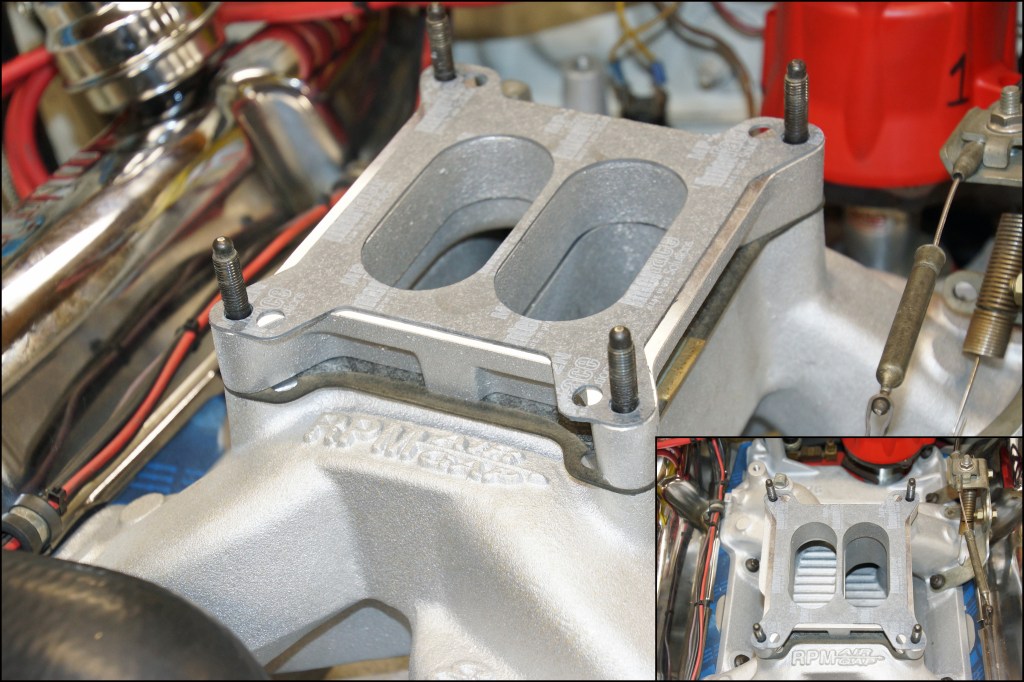
The last carburetor spacer was the Edelbrock divided plenum spacer that blended well into the divided plenum manifold. The combination did not perform as well as expected. The 60’ time was way off resulting in a lack luster 1.585 seconds and an 11.539 ET at 115.05 mph.
We towed the Dart to Beaver Springs Dragway for the baseline testing on one of the tracks test-and-tune days. Beaver Springs Dragway is a great little track located in central PA with plenty of nostalgic character that more than makes up for the fact that the track tends to be a bit slower than the other tracks in the area. Once unloaded, the Dart glided through tech, and the 340 and drivetrain were warmed up to normal operating temperature. The Dart was prepped for the first run of the day. The fuel cell was topped off with 93-octane fuel (pump gasoline), the tire air pressures were adjusted (15 psi for the slicks and 45 psi for the skinnies up front), the windshield was cleaned, and the weather station was set up before the Dart was tooled to the scales to verify the weight. The Dart weighed 2874lbs, and the driver added another 200lbs. After the weigh in, the Dart was moved to the staging lanes. Once in the bleach box, a quick burnout of the 26” x 9” Hoosier slicks brought the tire temperature up while at the same time cleaning off the tires. The Dart rolled forward stopping when the pre-staged beam was broken. The 340 revved to 3500 rpm, and the Dart was carefully bumped into the stage beam. The Christmas tree counted down the lights, and with the flicker of the last amber, the Dart was quickly off marching down the tarmac. A yank of the B&M shifter handle at every flash of the shift light (6200 rpm) stirred the Torqueflite through the gears. The result of the Torker II and the tapered four-hole spacer testing was a best ET of 11.374 at 114.94 mph with a 60’ time of 1.503 seconds at a density altitude (DA) of 143’ above sea level. Three additional runs netted an ET range of 11.374 to 11.391 seconds. The weather correction factor (WCF) of the best run of 1.008 provided a corrected run ET of 11.371 at 115.035 mph. All the runs were made in a slight crosswind that had no impact upon the ET or mph results. Based upon the finish line trap speed of the best WCF run, the 340 churned out a respectable 371.3 rear wheel horsepower (rwhp).
Swapping Manifolds
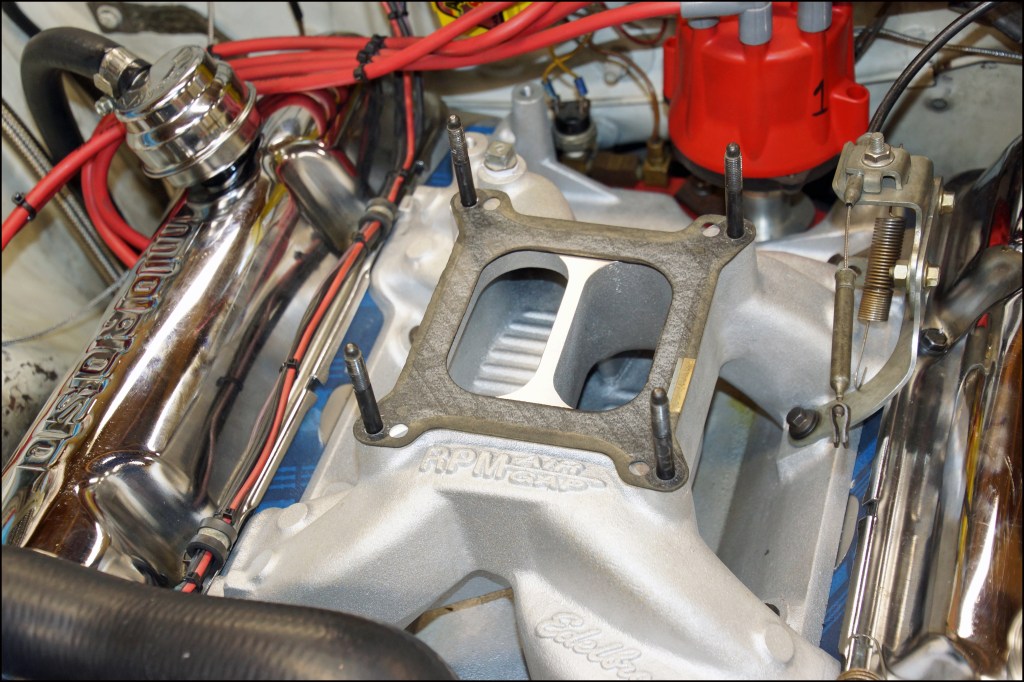
Swapping the manifolds took an afternoon to complete. The air cleaner, throttle linkage, fuel lines, return springs, carburetor fasteners, and carburetor were removed. The manifold fasteners were removed after the radiator and bypass hoses were separated from the manifold. The thermostat housing and thermostat were swapped from the Torker II manifold to the Performer RPM Air-Gap. The RPM Air-Gap was torqued into place, and the above disassembly was reversed to complete the installation.
The manifold swap is a straightforward task that can be completed in an afternoon. A quick removal of the air cleaner housing allowed access to the carburetor. The AN fuel lines were unthreaded from the Holley’s float bowls, the throttle cable was freed from the carburetor’s throttle linkage, the carburetor fasteners were removed, and the carburetor was pulled and set aside for later use. The coolant (water) was drained from the cooling system, and the upper radiator hose and the bypass hose were removed from the manifold. All the manifold fasteners were removed, and the manifold was lifted off the 340 and set to the side. The used intake manifold gaskets were cleaned from the cylinder heads and the engine block. Care was taken to ensure no gasket material dropped into the lifter valley of the 340. A new pair of Fel-Pro intake gaskets were laid into place along with the cork end seals. A dab of RTV was applied at the four points were the cork end seals met the intake manifold gaskets. The prepped (gasket-matched and casting flashing removed) Performer RPM Air-Gap was placed onto the new gaskets, and the manifold fasteners were torqued to 35 ft-lbs. The thermostat housing and thermostat were removed from the Torker II manifold. After cleaning the thermostat housing and installing a new gasket, the thermostat housing and the used 160F thermostat were torqued into place on the manifold. The CSR tapered 4-hole carburetor spacer and gaskets were removed from the Torker II manifold and slipped onto the Performer RPM Air-Gap manifold. With the carburetor torqued (80 in-lbs) to the manifold, the throttle cable was reconnected and adjusted to ensure wide open throttle (WOT) was achieved without any binding or restricting of the throttle pedal movement. The fuel lines were reinstalled, and with the fuel pump turned on, a thorough check revealed no fuel leaks. With the intake manifold swap completed, the 340’s oil was drained, and seven quarts of fresh 5w-30 was poured into the crankcase. The coolant was topped off, the engine was started and warmed up, and again, no leaks (fuel, coolant, or oil) were noted. The routine weekly maintenance was performed, and the Dart was prepped for the next weekend’s test-and-tune session.
Testing the Performer RPM Air-Gap Manifold
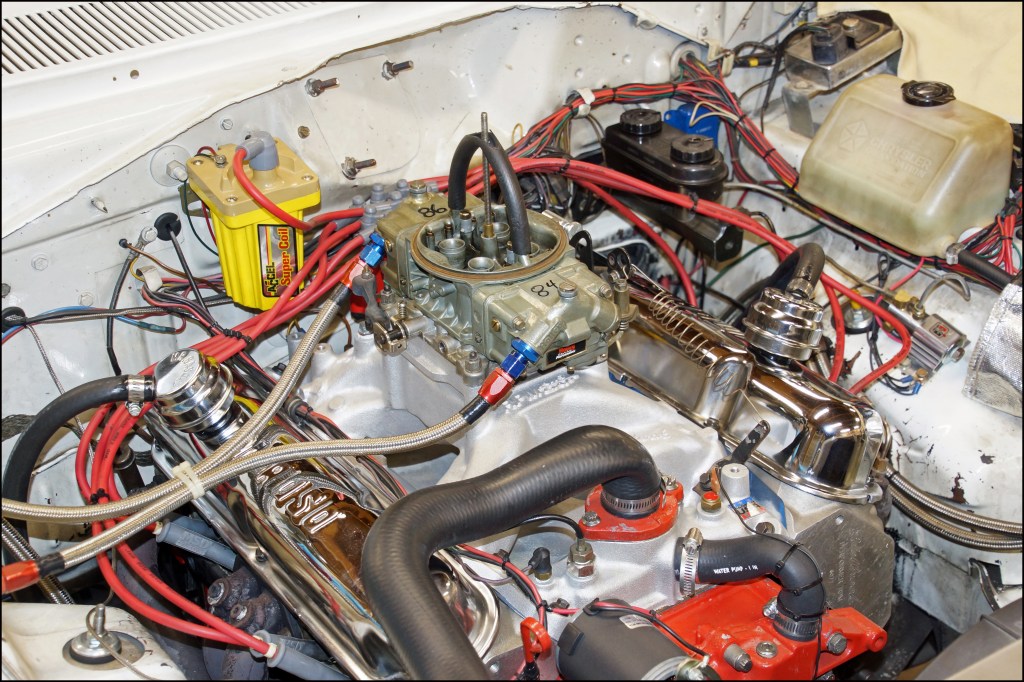
The 340 performed great during all the tests. The RPM Air-Gap manifold behaved well with great idle characteristics, and the manifold with either CSR carburetor spacer pulled hard down the track. Both of the CSR spacers required very few adjustments to the combination to maximize the engine’s performance. The Edelbrock spacer did not fare as well. Radical jetting and discharge nozzle changes did not help the performance much. Regardless of the performance, more testing in more diverse weather conditions may produce different results.
Saturday arrived with weather nearly identical to the moderate cool temperature of the previous test-n-tune weekend. The same pre-run procedures were performed on the Dart as the preceding practice session. The Dart was again weighed on the Beaver Springs scales, and the Dart weighed the same amount as the previous week, but this time the driver was a pound lighter. The driver’s diet is coming along well. On the track, the Dart was staged after a brief burnout. When the tree came down the Dart launched hard, and the front tires lifted about 4” off the track. The 340 marched down the track pushing into a constant breeze blowing out of the 11 o’clock direction at about 8-mph to the tune of an 11.408 at 115.45 mph with a lazy feeling 60’ of 1.542 seconds. The interesting part of the run occurred about 60’ from the finish line. The 340 hit the 6600 rpm rev limiter. This is something that has only happened one other time, and that occurred right at the finish line stripe not the entire speed trap. The initial results of the Performer RPM Air-Gap and the 1-inch 4-hole spacer were encouraging. Back in the pits, a minor adjustment of the Holley’s primary accelerator discharge nozzle squirter from a .035” to a .037” and a click of the rev limiter to 6800 rpm had the Dart ready for the next run. The second run again pulled the front skinnies off the track, and this time as the Dart approached the speed traps, the rev limiter was not touched at the end of the track. The run resulted in an 11.359 at 116.38 mph, and the 60’ had dropped to 1.535 seconds. The subsequent runs with the 4-hole spacer resulted in ETs ranging from 11.359 to 11.373 seconds. All the RPM Air-Gap runs (except the first run) with the 1-inch CSR 4-hole spacer were better than the baseline best with the Torker II and the 4-hole spacer. The WCF of the best run was 1.012 which resulted in a weather corrected 11.344 at 116.695 mph. Based upon the WCF trap speed of 116.695 mph, the 340 was laying down 381.4 rwhp. There was no correction for the wind, but there was likely a slight influence upon the performance of the Dart pushing into the wind.
The next setup was to remove the 4-hole spacer and replace it with the CSR 1-inch open plenum spacer. With the rev limiter still set to 6800 rpm and a 9-mph breeze coming from the 10 o’clock direction, the Dart was put through the paces for another series of runs. The first of the runs was the best with an 11.285 at 116.21 mph with a 60’ of 1.532 seconds. The 1/8 mile ET dropped into the 7.0s for the first time ever with a 7.096 at 94.670 mph. The 340 pulled very hard through the mid-to-upper RPM range. The open plenum spacer on top of the divided plenum manifold seemed to work very well with the 340. All of the runs with the open plenum were packed together in a range of 11.285 to 11.299 seconds. The arrangement was very repeatable, and the 60’ times were all in the 1.53 second range resulting in small wheelies on each run. The WCF of the best run was 1.019, which translates into an 11.245 at 116.731 mph run. The weather corrected 116.731 mph trap speed rendered 381.7 rwhp. With some additional refinement to the carburetor, this potent combination could likely see a slight improvement in performance, but the tune was so close no jetting changes were performed.
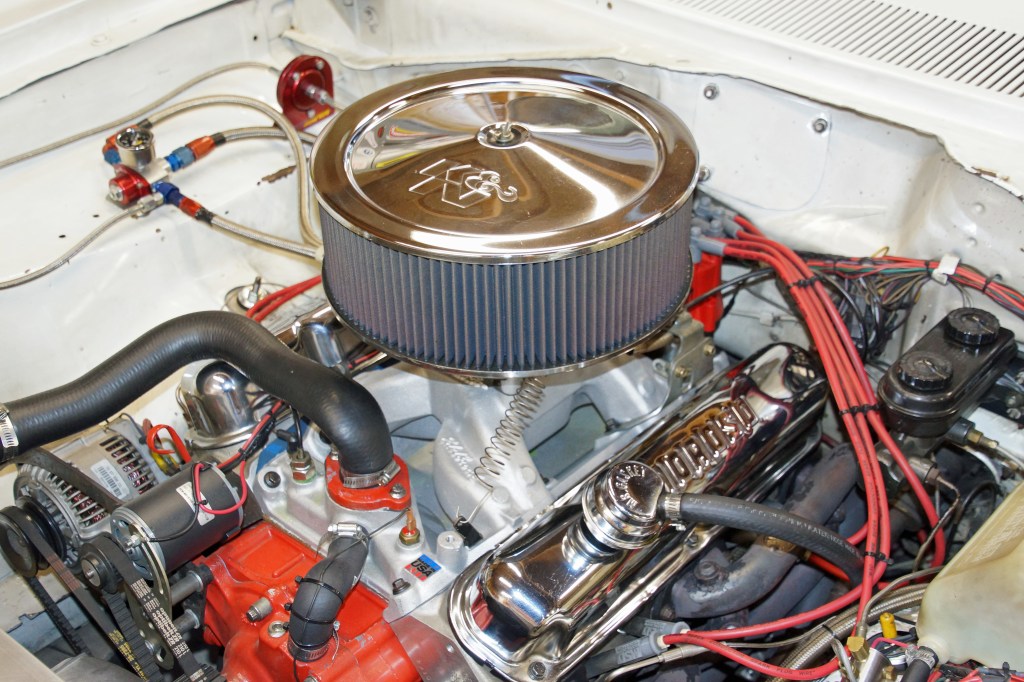
With the K&N air filter housing in place, very few people will know that you have a spacer on the manifold. If someone notices the spacer, the design of the spacer and the performance benefit still will not be known unless you share your results. With all the testing and accurate note taking, you have solid data that can be referenced for future performance upgrades.
The last 1-inch spacer to test was the divided plenum spacer from Edelbrock. With the new spacer in place, the 340 did not seem as happy running down the track, into an 8-mph head wind pushing down the strip from the 11 o’clock direction, as it had with the previous spacer tests. The 60’ times were up to the 1.57-1.59 second range, and the front tires never left the track. Down track, the 340 seemed lazy, and the ET slips proved this arrangement was off the pace of the other two spacers. The best run resulted in an off the pace ET of 11.539 at 115.06 mph. The WCF for the best run was up to 1.036, which worked out to be an ET of 11.412 at 116.492 mph. The WCF trap speed of 116.492 mph still showed an increase in horsepower over the baseline, but the elapsed times were a major disappointment when compared to the elapsed times of the other spacers. The divided plenum spacer on the RPM Air-Gap manifold did not allow the Dart to get out of the hole with any type of effectiveness even with major jetting and discharge nozzle changes.
Conclusion
There is no single carb spacer that will be the “magic bullet” for every engine. There will always be tradeoffs for every carb spacer selected. For every torque or horsepower benefit the spacer provides, there will be an offsetting loss of torque or horsepower at another point in the power curve. The key is finding the best spacer to maximize your particular needs to achieve the (in our case) fastest mph, the lowest ET, or the most repeatable set up. The open plenum carb spacer proved to be very beneficial for our combination with the RPM Air-Gap dual-plane manifold. Would this be the best carb spacer for a hot and sultry summer day? We do not know for sure, so more testing is the only answer to determine how the spacer would fare in different weather conditions. If an internal change was made to the engine (camshaft, heads, different stroke, etc.), all the spacer data could be thrown out the window, and again, more testing would verify what is successful and what is not. Most of the time, the use of carb spacers will assist the performance as the spacers are a fine-tuning point for your combination, and the spacers are not a method of adding huge amounts of torque or horsepower simply through an installation.
A final interesting point about all this testing is the fact that dual-plane Performer RPM Air-Gap manifold outperformed the single-plane Torker II manifold when all the other parameters remained the same. Conventional thinking maintains the belief that the single-plane would suffer on the low-end of the power band, but it would show its performance gains in the upper rpm range. With the assistance of a tapered four-hole carb spacer to gain some low-end torque, the Torker II provided solid 60’ times, but trap speeds of only 115 mph. Meanwhile, the dual-plane in conjunction with the tapered four-hole spacer, which should have shown better lower rpm performance, did well off the line with slightly slower 60’ times, but the trap speeds greatly outpaced the single-plane manifold. The results seem to throw the well-accepted theories about single- or dual-plane manifolds out the window. Both manifolds performed opposite of what was expected. Without performing this series of tests in “real world” conditions, none of this information would have been known. Your results may differ, and the only way to know what manifolds and carb spacers will work for you is to go out and test. Enjoy your time at the track.
 Mopower Garage
Leave a comment