Published by Christopher J. Holley | Mopar History & Tech | January 2026
By the late 1970s, horsepower was a dirty word, emissions rules were tightening by the month, and most American engines felt like they were breathing through a straw. Chrysler, already under financial strain, did not have the luxury of clean-sheet engine programs. What it did have was one of the toughest, most reliable engines ever put in a production car: the 225 Slant Six.
What it lacked was punch.
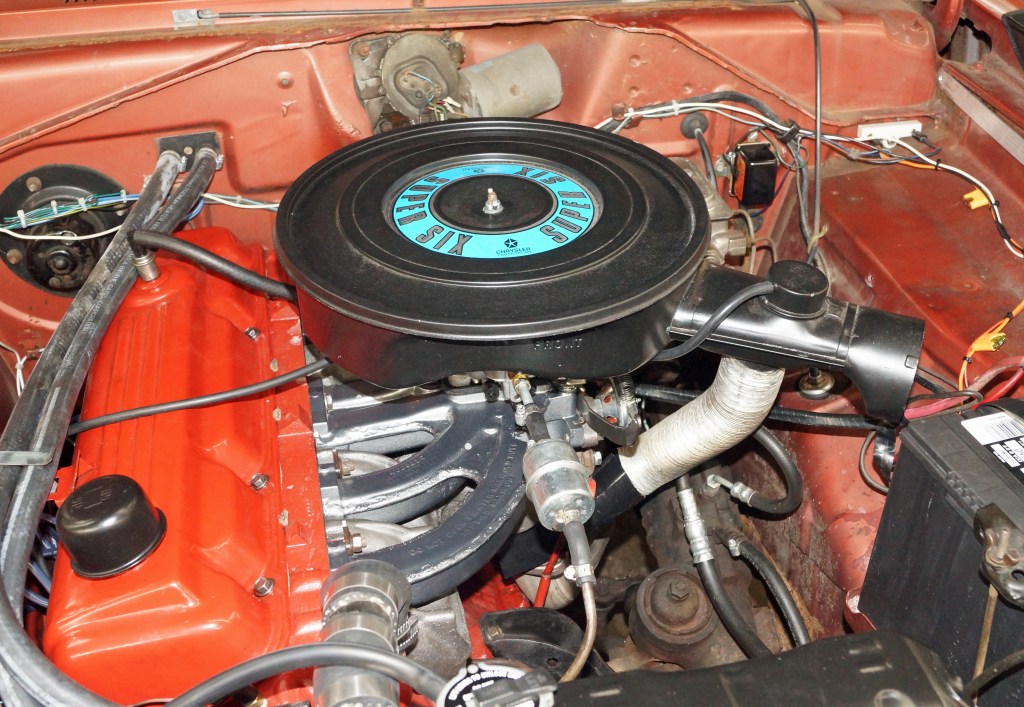
The answer was the Chrysler Super Six, a factory two-barrel version of the Slant Six that quietly became one of the smartest drivability upgrades of the Malaise era.
Not Early, Not Flashy but Effective
The Super Six appeared primarily as an option on 1977 and newer 225 Slant Six engines, most often in Dodge Aspens, Plymouth Volarés, light-duty trucks, vans, and other late-’70s Chrysler platforms.
This timing mattered. By 1976, even Chrysler’s famously durable six-cylinder was struggling under the weight of emissions hardware, lean calibration, and heavier vehicles. The one-barrel carburetor that worked fine in earlier A-bodies simply was not cutting it anymore.
Rather than abandon the Slant Six, or force buyers into strangled small-block V8s, Chrysler engineers made a practical, cost-conscious decision: let the engine breathe.
What Made It a “Super” Six
At its core, the Super Six was still the familiar 225 cubic-inch Slant Six, unchanged internally. Same forged crank, same rods, same block architecture that earned the engine its legendary reputation for surviving abuse and neglect.
The improvements were all concerning airflow and drivability:
- Two-barrel carburetor (most commonly a Carter BBD)
- Unique cast-iron (or aluminum) 2-barrel intake manifold
- Revised throttle linkage and emissions calibration
- Application-specific tuning to keep it emissions legal
No wild camshaft. No higher compression. No marketing hype about performance internals. Chrysler was not chasing peak horsepower; they were chasing usable torque and real-world responsiveness.
And it worked.
How It Drove
On paper, the numbers were not exciting. Depending on year and application, Super Six engines were typically rated around 110–115 horsepower. But that figure does not tell the story.
Compared to the one-barrel version, the Super Six delivered:
- Sharper off-idle throttle response
- A noticeably stronger mid-range
- Less throttle opening required to maintain speed
- Far better manners in heavier cars like the Aspen and Volaré
In daily driving, it felt like a different engine. Highway merges required less planning. Two-lane passes felt achievable. And in many cases, fuel economy stayed the same, or even improved, simply because the engine did not have to work as hard.
Against early Lean Burn 318s choked by emissions and timing strategies, the Super Six often felt more cooperative and predictable, especially in urban driving.
Why Chrysler Did It
The Super Six was not about excitement; it was about survival.
Chrysler needed:
- A way to improve customer satisfaction
- A fix that did not require expensive retooling
- An emissions-compliant solution using existing hardware
The Slant Six gave them that opportunity. Its robust design could tolerate changes without sacrificing reliability, and the two-barrel upgrade fit neatly within Chrysler’s emissions strategy of the late 1970s.
It was a classic Mopar move that was understated, practical, and engineered just well enough to solve the problem.
Why It Matters Today
For enthusiasts and restorers, the Super Six has become quietly desirable.
- The 2-barrel intake is a popular bolt-on upgrade for earlier Slant Six engines
- It is period-correct for late-’70s restorations
- It preserves originality while significantly improving drivability
- It reinforces what made the Slant Six special in the first place: longevity paired with simplicity
In an era defined by compromise, the Super Six stands out as one of the few factory solutions that genuinely improved the driving experience without undermining reliability.
The Slant Six, Finally Uncorked
The Chrysler Super Six was not fast. It was not flashy. It did not save the muscle car era.
But it did something arguably more important, it made a trusted engine better when it needed it most.
And in the late 1970s, that was no small achievement.


 Mopower Garage
Leave a comment