Published by Christopher J. Holley | Mopar History & Tech | January 2026
Inside Chrysler’s Seat Belt Interlock System and How It Was Tested
In 1974, Chrysler engineers found themselves building something no enthusiast had ever asked for and no driver would ever love. For one model year only, Dodge, Plymouth, and Chrysler passenger cars were equipped with a federally mandated seat belt starter interlock system. If the system was not satisfied, the engine simply would not crank.
Today, the 1974 seat belt interlock is often misunderstood, frequently disconnected, and rarely restored. Yet beneath its unpopular reputation lies one of the most complex safety systems ever installed in a muscle-era Mopar.
Why the Interlock Existed
The interlock system was not a Chrysler initiative. It was the result of Federal Motor Vehicle Safety Standard No. 208, which required that all 1974 passenger cars sold in the United States prevent engine starting unless front-seat occupants were properly restrained.
Earlier seat belt reminder buzzers had failed to significantly increase belt usage. Regulators responded by requiring direct control of the starter circuit. Manufacturers were instructed to eliminate common workarounds, such as buckling belts before sitting down or pulling belts tight behind the seat.
Chrysler responded with a system that enforced behavior, not just belt engagement.
Sequence, Not Simple Switches
Unlike earlier designs that relied on a single buckle switch, Chrysler engineered a logic-based system that monitored the order of events. The system required the driver and any front-seat passengers to enter the vehicle, sit down, and then buckle their belts before the starter relay would be energized.
Buckling the belt before sitting down would result in a no-start condition. Sitting down without buckling would also prevent starting. The system evaluated not only whether the belt was buckled, but when it was buckled.
The Hardware Behind the System
The 1974 Mopar seat belt interlock was an early solid-state system built around a transistorized logic module. Major components included seat-mounted weight switches, belt buckle switches, door jamb switches, a starter relay interrupt, a warning buzzer, a dash-mounted indicator lamp, and an under-hood bypass switch.
Unlike some earlier systems, Chrysler used buckle-mounted switches rather than retractor-based sensors. This improved reliability and allowed more precise monitoring of occupant behavior.
The interlock module interpreted all inputs in real time. If any required signal was missing or out of sequence, the module prevented the starter relay from engaging.
Every Front Seat Counted
Bench-seat vehicles introduced additional complexity. Federal regulations required that all front seating positions be monitored, including the center seat. If an occupant sat in the center position and did not buckle the belt, the system would block starting.
Many owners discovered this the hard way when a forgotten center belt left the vehicle immobilized in the driveway.
Starter Lockout Only
One persistent myth surrounding the interlock system is that it could shut off a running engine. This is incorrect. The system only controlled the starter circuit. Once the engine was running, unbuckling a seat belt had no effect on engine operation.
The interlock worked in series with the neutral safety switch on automatic transmission cars and the clutch switch on manual transmission models.
How Chrysler Tested the System
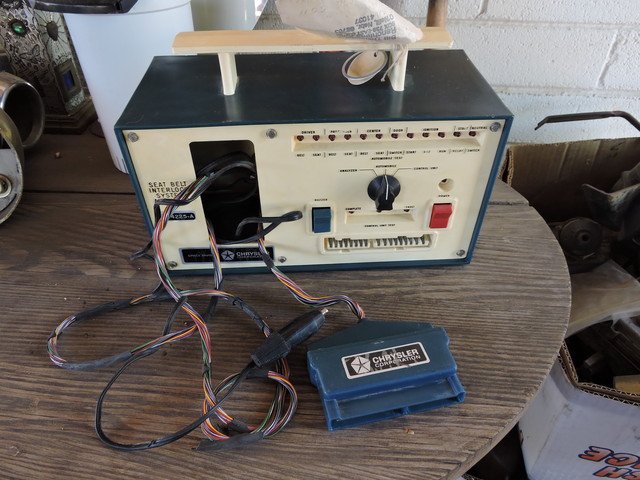
Because the system relied on logic rather than simple continuity, Chrysler developed dedicated diagnostic procedures and specialized dealer equipment.
Dealerships were supplied with a seat belt interlock analyzer designed to test the control module and its associated inputs. The analyzer allowed technicians to verify internal logic function, confirm switch operation, and identify wiring faults without unnecessary parts replacement.
This approach was advanced for the era and represented one of Chrysler’s earliest large-scale applications of solid-state diagnostics.
Functional Testing Procedures
Service manuals also outlined extensive functional tests that required technicians to physically perform various entry and buckling sequences. These included sitting before buckling, buckling before sitting, opening and closing doors mid-sequence, and testing each seating position individually.
Timing delays were also evaluated to ensure brief movements did not falsely reset the system. These procedures were time-consuming but necessary to verify proper operation.
The Bypass Switch
An under-hood bypass switch was included for service use. When pressed, it temporarily disabled the interlock and allowed the vehicle to start regardless of belt status. Once the ignition was turned off and sufficient time had passed, the system reset itself.
Although intended for diagnostics and emergency use, many owners relied on the bypass switch daily or permanently disconnected the system altogether.
Public Reaction and Repeal
The reaction to the interlock system was swift and overwhelmingly negative. Drivers objected to vehicles that refused to start, dealers struggled with diagnosis, and lawmakers received widespread complaints.
By late 1974, Congress repealed the starter interlock requirement. Beginning in 1975, manufacturers returned to warning systems rather than starter lockouts. The 1974 model year remains the only time such a system was federally mandated.
Why It Still Matters
For restorers, the 1974 seat belt interlock presents a decision. Some choose full restoration for authenticity, others opt for discreet bypassing, and many remove the system entirely.
From an engineering perspective, the system represents a moment when mechanical muscle cars intersected with electronic logic. Chrysler did not fail to meet the requirement. Instead, it demonstrated just how far engineering could go when compliance became mandatory.
 Mopower Garage
Leave a comment