
Published by Christopher J. Holley | Mopar History & Tech | February 2026
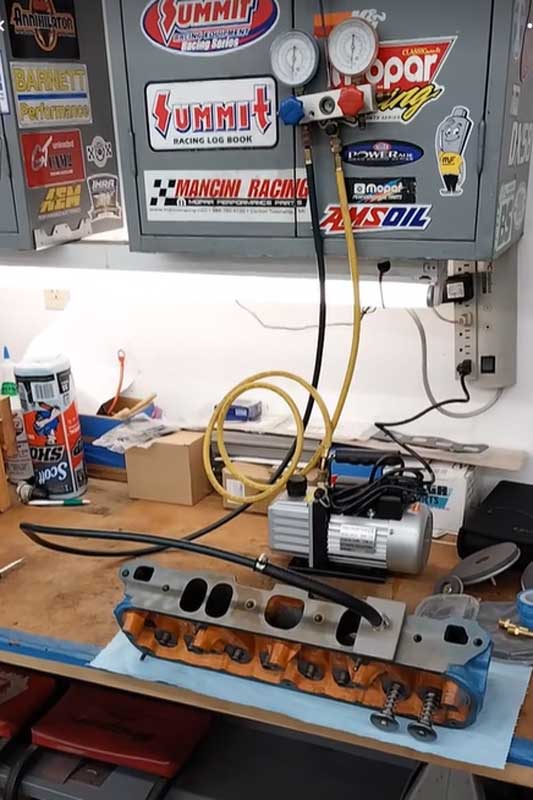
There are many ways to evaluate a valve job, but few are as revealing as a vacuum test performed on the bench before the cylinder head ever goes near an engine. With no combustion pressure, no piston movement, and no ring seal to mask imperfections, this method isolates one thing and one thing only: how well the valves seal against their seats.
When each port is tested individually using a vacuum pump and properly sealed port plugs, the results provide an unfiltered look at machining quality. Unlike a traditional leak-down test, which evaluates the entire cylinder assembly as a system, a bench vacuum test focuses solely on the relationship between the valve, the seat, and the guide. If those three elements are correct, vacuum builds quickly and holds. If they are not, the gauge tells the truth immediately.
Proper setup is critical. All intake and exhaust ports are sealed except the one being tested, and spark plug holes are blocked to eliminate leakage paths. The vacuum pump is connected directly to the open port, creating a sealed chamber between the valve face and the seat. Each port is tested individually, allowing direct comparison from cylinder to cylinder and valve to valve.
A quality valve job reveals itself quickly on the gauge. Vacuum rises smoothly as the pump is applied, with no hesitation or flutter. Intake ports typically pull in the range of 25 to 28 inches of mercury, while exhaust ports often read slightly lower, commonly between 22 and 26 inches, depending on valve size and seat width. More important than the absolute number is stability. A steady needle and slow leak-down, often only one or two inches over ten to fifteen seconds, indicates uniform seat contact around the full circumference of the valve.
When problems exist, the gauge behavior changes. A slow vacuum build or low peak reading often points to incomplete seat contact or poor concentricity between the valve and the seat. A port that reaches good peak vacuum but leaks down rapidly suggests the valve is touching the seat in some areas but not sealing continuously. In these cases, adding a small drop of light oil or solvent at the valve margin can be revealing. If vacuum improves noticeably, the issue is almost always related to seat finish or contact pattern.
Needle flutter is the most concerning sign. Flutter indicates uneven seat width, guide misalignment, or a valve face that is not square to the guide axis. These issues are typically machining-related and rarely corrected with lapping alone. They require attention to seat geometry or guide alignment.
Intake and exhaust results should be compared carefully. Intake valves generally seal better due to their size and seat design, while exhaust valves often show slightly lower readings because of wider seats intended for heat transfer. What matters most is consistency. Intake ports should read within about one inch of mercury of each other, and exhaust ports should show similar uniformity. A single weak port in an otherwise strong set is a clear warning sign.
Both bare and assembled heads can be tested using this method. Bare head testing evaluates machining accuracy without spring load, while assembled head testing reflects real-world conditions and can uncover problems such as retainer interference, valve seal contact, or spring-induced side loading. Many experienced builders perform both tests to fully qualify a valve job.
A simple but effective additional check is to flip the head over and repeat the test. A properly aligned valve should not show significant changes in vacuum due to gravity alone. If readings change noticeably, guide alignment is often the culprit.
Testing each port individually is what gives this method its real value. It exposes inconsistencies that might otherwise remain hidden until the engine is running, or worse, until a valve begins to fail. This is why the technique is trusted in professional race shops and remains just as relevant for high-compression street engines and restored performance builds.
A fresh valve job that builds vacuum smoothly, pulls strong and consistent numbers, and holds steady under test is a valve job you can trust. If it does not pass this test on the bench, it is unlikely to improve once the engine is fired. Sometimes the quietest test delivers the loudest verdict.
 Mopower Garage
Leave a comment