
Published by Christopher J. Holley | Mopar History & Tech |February 2026
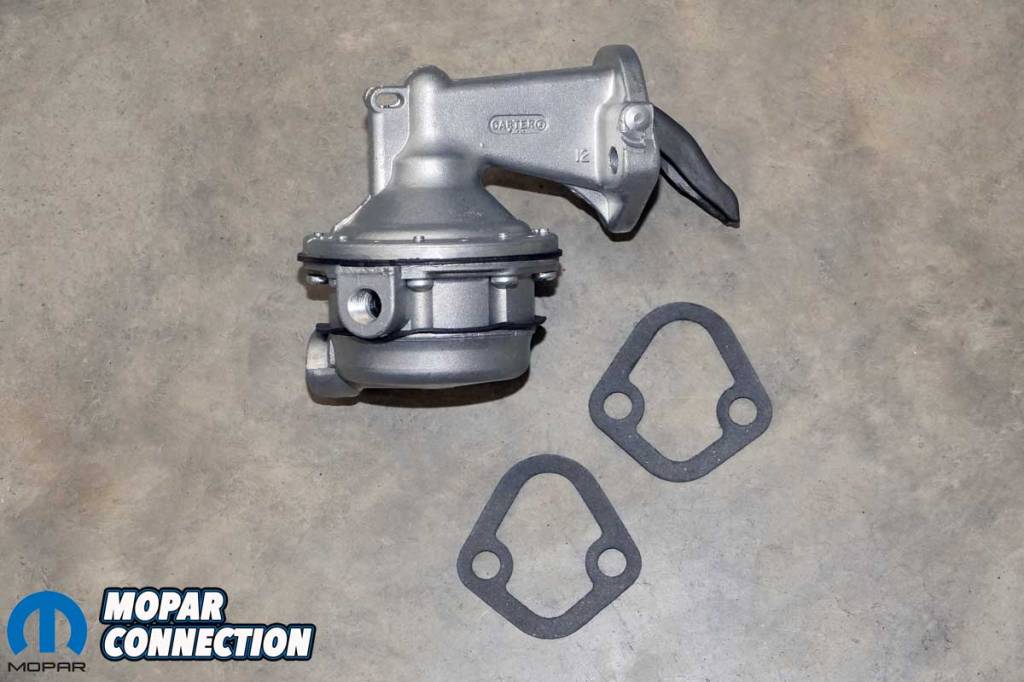
A mechanical fuel pump is delightfully old-school. No wires, no sensors, just motion, springs, and pressure doing honest work.
Here is how it operates, step by step.
At the heart of the pump is a lever or pushrod that rides on an eccentric lobe on the engine’s camshaft. Every time the cam turns, that eccentric pushes on the pump’s lever. This movement pulls down on a flexible diaphragm inside the pump.
When the diaphragm is pulled downward, it creates low pressure (vacuum) inside the pump chamber. That vacuum opens the inlet check valve, allowing fuel to be drawn from the fuel tank into the pump.
As the camshaft continues to rotate, the eccentric moves away. A return spring pushes the diaphragm back upward. This upward motion pressurizes the fuel inside the chamber, closing the inlet valve and opening the outlet check valve, sending fuel toward the carburetor.
That cycle repeats constantly while the engine is turning.
A key detail that makes this system elegant is self-regulation. When the carburetor float bowl is full, fuel pressure builds in the outlet line. That pressure resists the diaphragm’s movement, so even though the cam is still moving the lever, the diaphragm does not complete a full stroke. The pump effectively goes into a partial stroke mode until more fuel is needed.
Most mechanical fuel pumps are designed to deliver low pressure, typically in the 4 to 7 psi range for carbureted engines. That pressure is ideal for needle-and-seat carburetor systems and is controlled by diaphragm spring tension rather than a separate regulator.
There are a few common layouts. Some engines use a direct lever-style pump bolted to the block. Others use a pushrod-actuated pump, where the camshaft moves a steel rod that pushes on the pump arm. Either way, the principle is identical.
The strengths of mechanical pumps are simplicity, reliability, and period correctness. Their weaknesses are just as clear: they only pump when the engine is turning, they are sensitive to heat soak and vapor lock, and they cannot easily support high-pressure fuel injection systems.
In short, a mechanical fuel pump is an engine-driven vacuum and pressure machine, using camshaft motion to pull fuel forward in precise, rhythmic pulses, perfectly matched to the needs of a carbureted engine.
 Mopower Garage
Leave a comment