
Published by Christopher J. Holley | Mopar History & Tech |February 2026
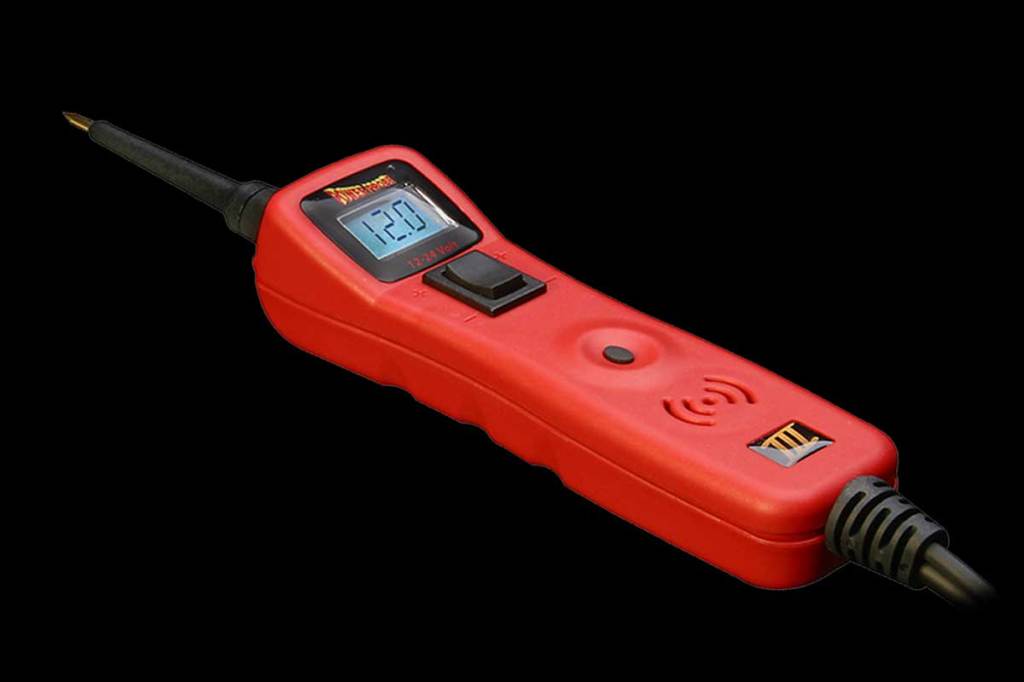
Few diagnostic tools generate as much enthusiasm, or as much controversy, as the Power Probe. To some technicians, it is an indispensable time-saver that cuts through electrical uncertainty. To others, it is a blunt instrument capable of inflicting costly damage when used improperly. As with most powerful tools, its true value depends entirely on the knowledge and discipline of the person holding it.
When used correctly, a Power Probe is one of the most effective electrical diagnostic tools available in the modern service bay. When used carelessly, it can quickly turn a simple wiring fault into a failed control module. Understanding both its strengths and its limitations is essential.
What a Power Probe Really Does
At its core, a Power Probe combines several fundamental electrical tools into a single handheld device. It functions as a digital voltmeter, a ground tester, a controlled power source, and a circuit loading device. Connected directly to the vehicle battery, it allows the technician to observe voltage, identify polarity, apply battery voltage, or apply ground at the probe tip.
Unlike a traditional digital multimeter, the Power Probe does not merely observe circuit conditions. It can actively energize a circuit, allowing technicians to see how components respond under real operating conditions.
Equally important is understanding what the Power Probe is not. It is not a scan tool, not a logic analyzer, and not a substitute for wiring diagrams or electrical theory. It is also not safe for use on every circuit found in modern vehicles. In short, the Power Probe delivers fast answers only when the technician already understands the system being tested.
Why Technicians Rely on It
The appeal of the Power Probe lies in its ability to give the technician immediate authority over the circuit. With the press of a trigger, battery voltage or ground can be applied and the result observed instantly.
The capability allows technicians to answer critical diagnostic questions quickly. Is the component itself capable of operating? Is the wiring intact between the power source and the load? Is the fault located in the control logic or in the circuit itself? In a flat-rate environment, these answers translate directly into saved time and increased efficiency.
Voltage Identification and Polarity Testing
Most Power Probes provide a digital voltage display along with clear polarity indicators. That makes it easy to identify constant power, switched power, and ground circuits immediately.
The Power Probe’s polarity indicators feature is particularly useful when diagnosing blown fuses, open circuits, poor grounds, and incorrect wiring repairs. It also provides immediate visual feedback that helps less-experienced technicians better understand circuit behavior.
In instructional settings, Power Probe use should complement, not replace, the digital multimeter. Using both tools reinforces proper diagnostic habits while demonstrating the advantages of circuit loading.
Circuit Loading and Real-World Testing
One of the Power Probe’s greatest strengths is its ability to place a load on a circuit. High-impedance meters can display acceptable voltage even when corrosion, damaged wiring, or loose connections are present. Under load, that same voltage may collapse.
By applying power or ground through the probe, high-resistance faults quickly reveal themselves. Corroded splices, compromised grounds, and partially broken wires become obvious when voltage drops under load. The ability to expose hidden faults explains why many experienced technicians rely heavily on the tool.
Direct Component Testing
The Power Probe excels at bypass testing, allowing components to be tested independently of the vehicle’s control system. Applying power directly to a component can immediately confirm whether it can operate.
Cooling fan motors, window and seat motors, relay coils, and fuel pump circuits are common examples. If the component operates when powered directly, the problem lies elsewhere in the wiring or control logic. If it does not, the component itself is faulty. Few diagnostic steps provide such clear and immediate answers.
Ground Verification
Poor grounds remain one of the most common causes of electrical problems in vehicles. The Power Probe allows technicians to apply a known good ground and observe the circuit’s response instantly.
The quick response makes it especially effective for diagnosing lighting issues, body electrical complaints, and accessory failures. A circuit that functions correctly when grounded directly through the probe but fails otherwise points directly to a grounding problem.
Where the Tool Becomes Dangerous
The same ability to apply battery voltage that makes the Power Probe useful also makes it dangerous. Applying twelve volts to the wrong circuit can cause immediate and irreversible damage.
Battery voltage should never be applied to engine or powertrain control module signal pins, CAN or LIN communication circuits, five-volt reference circuits, Hall-effect sensor signal wires, supplemental restraint system circuits, or electronic throttle control systems. Generally, if a circuit normally operates below twelve volts, it should never be powered with a Power Probe.
A single careless trigger pull can destroy a control module and turn a minor wiring issue into an expensive repair.
Best Practices for Safe and Effective Use
Experienced technicians treat the Power Probe as a precision diagnostic instrument rather than a shortcut. Best practice begins with observation. Voltage and polarity should be identified before any power is applied, and wiring diagrams should always be consulted.
Fused leads should be verified before use, and connectors should be back-probed rather than pierced to preserve wiring integrity. Power Probe diagnostics should also be paired with scan tool data. The probe can confirm whether a component will operate, while the scan tool explains why it was not commanded to do so.
A Tool, Not a Replacement
The Power Probe does not replace traditional diagnostic tools. It complements them. Digital multimeters provide precision and safety. Test lights offer simplicity. Oscilloscopes reveal timing and data integrity. The Power Probe delivers speed and real-world functional testing.
In the hands of a trained professional, it is an efficient path to the truth. In the hands of the careless, it becomes an expensive lesson. Like any powerful diagnostic tool, its value depends entirely on the knowledge and judgment of the technician using it.
 Mopower Garage
Leave a comment