
Published by Christopher J. Holley | Mopar History & Tech |February 2026
In every pushrod engine, whether it is a vintage small-block or a modern Hemi, the camshaft is the quelled conductor of the valvetrain orchestra. Each lobe on that shaft is a specifically engineered shape that regulates when a valve opens, how far it opens, how long it stays open, and how gently it returns to its seat. Understanding the anatomy of a camshaft lobe demonstrates just how much thought is packed into what appears to be a simple egg-shaped bump of steel.
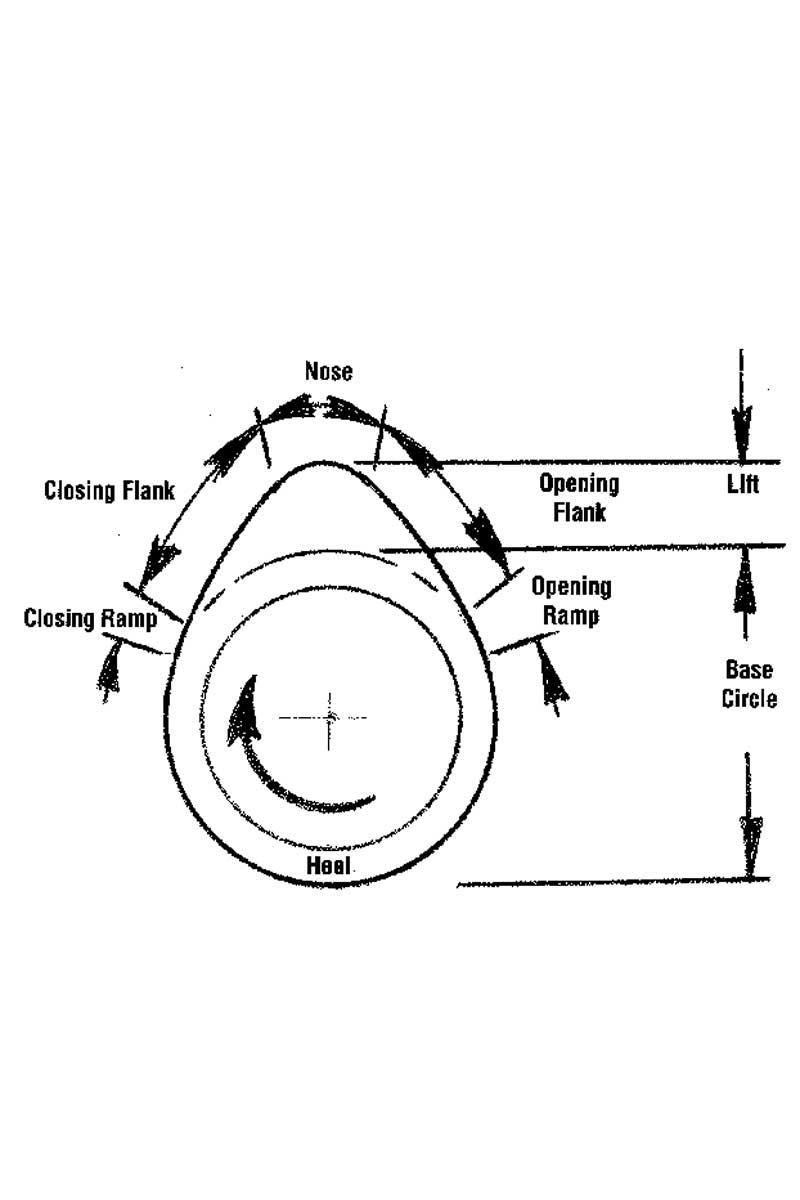
At its foundation is the base circle. The heel (base circle) is the perfectly round portion of the lobe where no valve lift occurs. When the lifter or follower rides on the base circle, the valve is fully closed. The diameter of the base circle is crucial because it establishes lifter preload in hydraulic systems and valve lash in solid lifter combinations. Cam grinders often decrease the base circle when increasing lobe lift on a stock core, a detail that matters during installation and geometry setup.
Moving off the base circle, the lifter encounters the opening ramp. This portion of the lobe helps the valvetrain move. In a hydraulic camshaft, the opening ramp takes up clearance smoothly and allows the lifter plunger to stabilize. In a solid lifter design, it gently removes lash before the more aggressive lift curve begins. Ramp design is one of the key differences between a mild street cam and a high-rpm racing profile. Too aggressive, and valvetrain components suffer. Too lazy, and performance is left on the table.
After the opening ramp, the flank is where real acceleration happens. The flank is the steeply rising section of the lobe that drives the lifter upward, converting rotational motion into linear lift. The rate of lift here determines how quickly the valve gets off the seat and into the airflow window. Faster lift rates improve cylinder filling at higher engine speeds, but they demand stronger springs, lighter valvetrain components, and more rigid pushrods and rocker arms.
At the top of the lobe is the nose. The nose represents maximum lift, where the valve is open the farthest, allowing the cylinder to ingest air-fuel mixture or expel exhaust gases. The nose shape determines how long the valve hovers at peak lift. A broader nose can provide more area under the lift curve, improving breathing without necessarily expanding advertised duration.
As the camshaft continues to rotate, the lifter transitions onto the closing flank. Much like the opening side, this section controls how quickly the valve returns toward its seat. The closing ramp then gently eases the valve back into contact with the seat, preventing bounce and minimizing wear. Proper closing control is critical. Valve bounce can cause lost compression, an unstable idle, and, in extreme cases, piston-to-valve contact.
The entire lobe operates in constant contact with a lifter, whether flat tappet, roller, or overhead follower. In flat-tappet systems, the lifter face is slightly crowned, and the lobe is ground with a taper. The subtle tapered geometry induces lifter rotation, which spreads wear across the surface. In roller systems, a wheel follows the lobe profile, reducing friction and allowing more aggressive ramp rates.
What makes a camshaft lobe remarkable is that it does not merely lift a valve. It manages acceleration, velocity, and jerk in a carefully calculated sequence measured in thousandths of an inch and fractions of a degree. At 6,000 rpm, each lobe cycles 3,000 times per minute. Multiply that by eight cylinders, and the camshaft becomes one of the hardest-working components in the engine.
From the calm precision of the base circle to the controlled violence of the flank and the authority of the nose, every section of the camshaft lobe plays a role in shaping an engine’s nature. Idle quality, throttle response, vacuum signal, peak horsepower, and durability all trace back to the geometry sculpted into that spinning shaft. It is not just a bump on a stick. It is the blueprint of combustion, rotating in steel.
 Mopower Garage
Leave a comment