Published by Christopher J. Holley | Mopar History & Tech |February 2026
It rarely gets the spotlight. It does not make horsepower. It does not add torque. It does not shine under chrome valve covers or scream at 7,000 rpm. Yet without it, your engine would cook itself into a molten monument in a matter of minutes. The humble water pump is one of the hardest working components under the hood—and one of the least appreciated.
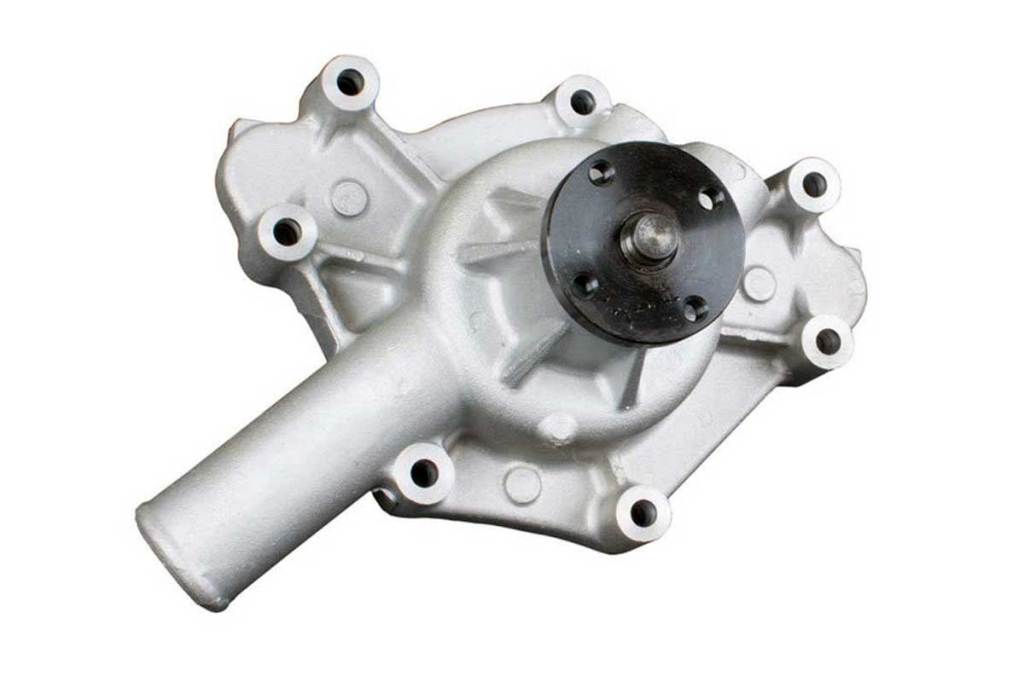
At its core, the engine water pump is a centrifugal pump designed to keep coolant moving continuously through the block, cylinder heads, radiator, and heater core. While the design has evolved over the decades, the fundamental architecture remains remarkably consistent.
The Housing: Foundation of the System
The pump begins with the housing, typically cast from iron or aluminum. Bolted directly to the engine block, the housing forms the coolant chamber and directs flow between the radiator and engine. It must withstand pressure, vibration, and constant thermal cycling.
Passages within the housing guide coolant into the pump’s inlet and route it toward the engine once it has been pressurized by the impeller. A precision-machined mounting surface ensures a tight seal against the block, usually with a gasket or O-ring preventing external leaks.
The Impeller: The Muscle Behind the Motion
Hidden inside the housing is the true workhorse—the impeller. This finned, wheel-like component spins at engine speed and is responsible for moving coolant.
As the impeller rotates, it draws coolant into its center, known as the “eye.” Centrifugal force then throws the coolant outward through the vanes, building velocity and pressure. That pressure differential is what drives coolant through the engine’s water jackets and into the radiator.
Impellers come in several materials. Older designs often used cast iron for durability. Later versions adopted stamped steel for cost efficiency. Many modern pumps now feature composite impellers, which reduce weight and resist corrosion.
The Shaft: The Connection to Power
The impeller does not spin on its own. It is mounted to a steel shaft that transfers rotational force from the engine’s drive system. Depending on the application, that drive may come from a V-belt, serpentine belt, timing belt, or even a timing chain.
The shaft must remain perfectly aligned under load. Any deflection can cause seal failure, bearing wear, or catastrophic leakage.
Bearings: Silent Support
Supporting that shaft are precision bearings pressed into the housing. These bearings are sealed and permanently lubricated at the factory. When they begin to fail, they usually announce their condition with a growl, grind, or wobble.
A worn bearing allows shaft play, which quickly compromises the mechanical seal. In many cases, bearing failure and seal failure go hand in hand.
The Mechanical Seal: Holding Back the Flood
Between the coolant side and the bearing side sits the mechanical seal. This component prevents coolant from traveling down the shaft and contaminating the bearings.
It operates under constant heat and pressure. Over time, wear or contamination can cause the seal to fail. When that happens, coolant escapes through a small passage called the weep hole.
The Weep Hole: The Early Warning System
The weep hole is a deliberate design feature. Located between the seal and the bearing cavity, it allows coolant to escape safely if the seal begins to leak. This prevents coolant from entering the bearing assembly and causing more severe damage.
A damp or dripping weep hole is often the first visible sign that a water pump’s service life is coming to an end.
The Pulley or Hub: Where Rotation Begins
Externally, the pulley or drive hub connects the water pump to the engine’s drive system. As the crankshaft turns, the belt spins the pulley, which rotates the shaft and impeller. On timing-driven designs, the pump’s rotation is synchronized directly with engine timing events.
Regardless of drive method, the principle remains unchanged: no rotation, no flow.
Continuous Circulation
When the engine is running, coolant is constantly in motion. The water pump pulls cooled fluid from the radiator, forces it through the engine block and cylinder heads to absorb heat, and then sends it back to the radiator to shed that heat. The process repeats endlessly.
The system must maintain adequate flow across a wide range of operating conditions—from cold starts to towing loads in summer heat. It is a simple design that performs a complex and critical task.
The Unsung Hero
The engine water pump may never headline a performance catalog, but it is foundational to engine survival. Its components—housing, impeller, shaft, bearings, seal, and pulley—work in quiet harmony to regulate temperature and preserve reliability.
In the hierarchy of engine components, it is not glamorous. It is essential. And sometimes, the parts that do not make noise are the ones that matter most.
 Mopower Garage
Leave a comment