
Published by Christopher J. Holley | Mopar History & Tech |February 2026
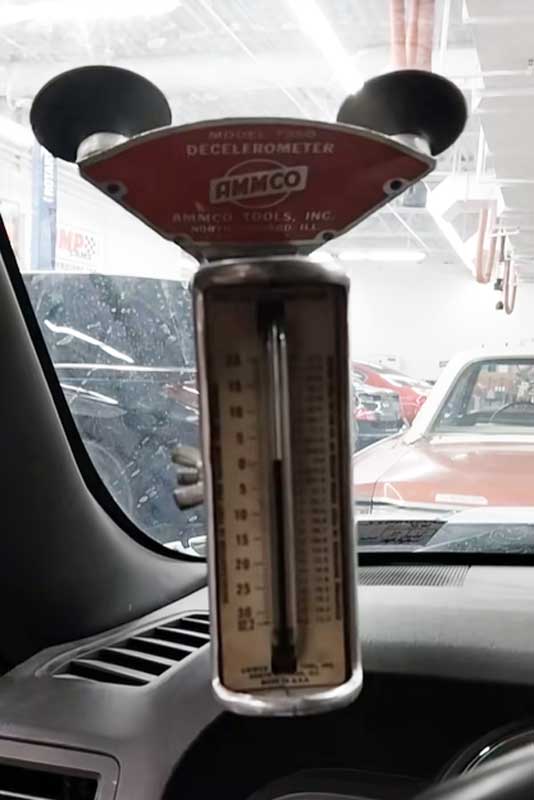
The Ammco Model 7350
Long before scan tools graphed brake pressure and anti-lock brake system events in real time, there was a simpler way to answer the most important question in any brake service.
Does it stop better now than it did before?
On the workbench of a midcentury service bay, next to drum micrometers, arc grinders, and a well-used Ammco brake lathe, one might have found a diminutive but purposeful tool labeled Model 7350. It was not a lathe, nor a thickness gauge. It was a decelerometer, a device designed to measure how quickly a vehicle slowed when the brakes were applied.
It was a modest tool with a serious purpose.
The Ammco 7350 was built around a straightforward principle. Braking performance is not only about pedal feel. It is about the rate of deceleration. The faster a vehicle sheds speed under controlled braking, the more effective the system is.
Mounted inside the passenger compartment, the 7350 registered vehicle deceleration as the driver applied the brakes. The reading provided technicians with something invaluable. It offered a measurable indication of brake performance. It allowed comparison between conditions before and after service. It provided objective proof for customers who required reassurance.
In an era when drum brakes dominated American highways and brake fade was a legitimate concern, this information carried weight.
The Model 7350 belonged to a period when automotive service required both craftsmanship and instrumentation. Shops did not merely replace parts. They affirmed performance.
A technician would complete the brake service with new shoes, machined drums, and renewed hardware. A controlled road test would follow with the decelerometer secured in position. The deceleration reading would be observed and recorded. The result could then be compared against a specification or previous measurements.
No wireless communication. No software calibration. Only mechanical measurement based on physics.
The instrument relied upon a weighted internal mechanism that responded to forward deceleration. A calibrated scale displayed the result, often expressed as a percentage of gravitational force. The metal housing was built to withstand repeated use in a professional shop environment.
The 7350 will never be mistaken for a brake lathe even with its strong association between Ammco and its machining equipment. It was intended to confirm results. After machining drums or rotors, the decelerometer verified whether stopping performance had been restored.
Today, the Ammco Model 7350 is most often discovered on auction listings or in collections of vintage service equipment. Modern brake testing frequently relies upon onboard diagnostics and computerized analysis. Yet the philosophy behind the 7350 remains applicable.
Effective service is not limited to component replacement. It is defined by measurable improvement.
For instructors, restorers, and experienced technicians, the 7350 serves as a reminder. Braking force can be felt, but it should also be measured. Performance gains should be demonstrated, not assumed. Competent service requires both skill and evidence.
The Ammco Model 7350 may not command the same attention as a large brake lathe or a modern diagnostic cart. Nevertheless, in its time, it provided something essential.
Confidence.
Confidence that the vehicle would stop properly.
Confidence that the service was performed correctly.
Confidence supported by measurable data.
In the field of brake service, that principle remains unchanged.
 Mopower Garage
Leave a comment