
Published by Christopher J. Holley | Mopar History & Tech |February 2026
The Middle Ground: Why Engineers Love the Strut–SLA Front Suspension
Front suspension design is always a compromise. Packaging, cost, geometry, ride quality, and assembly speed all wrestle for priority under the hood. Somewhere between the simplicity of the MacPherson strut and the precision of a true double wishbone lives a clever hybrid: the strut–short-long arm (SLA) setup.
It is not perfect. It is not exotic. But it is smart.
The Baseline: The MacPherson Strut
The MacPherson strut dominates the industry for a reason. Open the hood of a Toyota Camry or a Honda Civic and you will see it.
One lower control arm.
A tall strut that doubles as the upper locating member.
Simple. Compact. Affordable.
Its biggest strength is packaging. With only one control arm, it leaves room for transverse engines, tight engine bays, and efficient assembly. But geometry is its weakness. During cornering, a traditional strut tends to lose camber control. As the body rolls, the outside tire can tip onto its outer shoulder. Grip suffers.
For most commuters, that compromise is acceptable.
For engineers chasing better handling without blowing the budget, it is not.
The Gold Standard: True SLA (Double Wishbone)
Now look at a performance benchmark like the Chevrolet Corvette. That front suspension uses a true short-long arm design: an upper control arm and a longer lower control arm.
This configuration allows engineers to precisely control:
- Camber gain
- Roll center height
- Caster change
- Tire contact patch behavior
As the suspension compresses in a turn, the shorter upper arm pulls the top of the tire inward, generating negative camber. The contact patch stays flat. Grip improves. Steering feels sharper and more predictable.
The downside? More parts. More cost. More space required under the hood. That upper control arm must mount somewhere, and on modern front-wheel-drive platforms with wide engines, that space can be scarce.
Enter the Hybrid: Strut–SLA
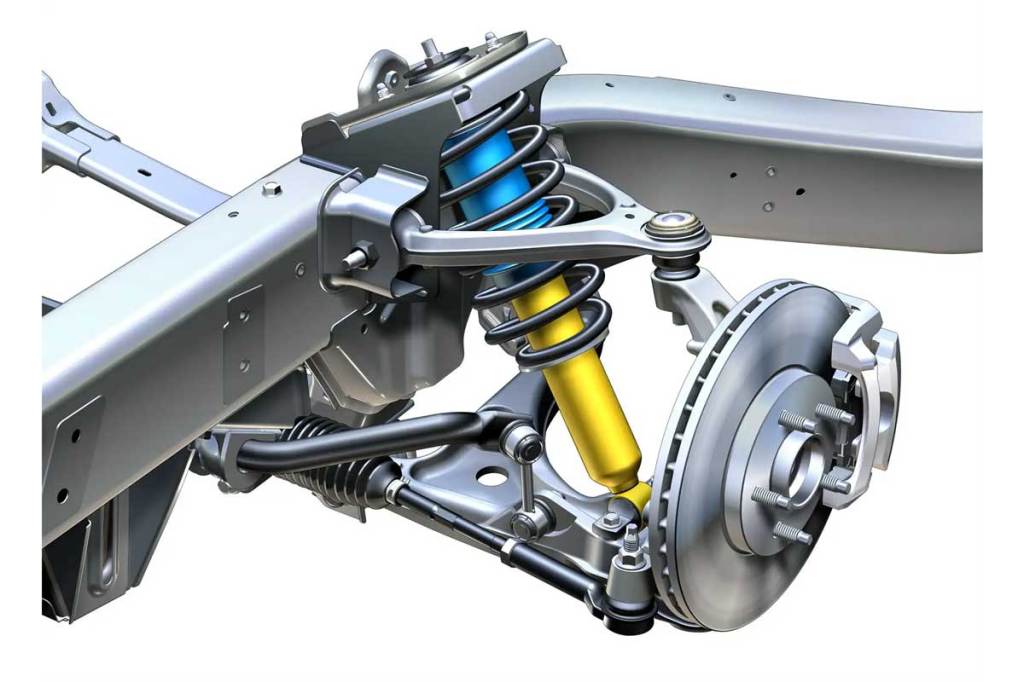
The strut–SLA front suspension is the engineer’s compromise.
It keeps the strut architecture for packaging and assembly efficiency but tweaks the geometry—often through control arm length, mounting points, or additional links—to improve camber behavior compared to a basic strut system.
You saw variations of this approach on platforms like the Ford Mustang, where engineers wanted better handling than a basic commuter car but needed to control cost and structure.
The result is a system that sits squarely between the two extremes.
What the Hybrid Does Better Than a Pure Strut
The biggest improvement is camber control.
A basic MacPherson strut can gain positive camber in roll. A strut–SLA configuration improves the camber curve, helping the outside tire stay more upright during aggressive cornering.
Handling improves.
Turn-in sharpens.
Tire wear becomes more even under spirited driving.
And yet, it still preserves:
- Narrow shock towers
- Preassembled strut modules
- Lower manufacturing cost than full double wishbone
For mass production, that matters.
Where It Still Falls Short of True SLA
The hybrid cannot match the tuning flexibility of a full double wishbone.
With true SLA, engineers can independently adjust upper and lower arm lengths, pivot angles, and roll center migration. The geometry toolbox is wide open.
With a strut-based system, the strut itself remains a structural member. That limits how much the camber curve and roll center can be manipulated.
In performance driving, the difference shows up at the limit. A double wishbone system generally provides:
- More consistent tire loading
- Better mid-corner stability
- Cleaner feedback through the steering wheel
The hybrid improves the strut. It does not replace the double wishbone.
Why Engineers Choose It
Suspension design is not about perfection. It is about balance.
| System | Cost | Packaging | Geometry Control | Performance Potential |
| MacPherson Strut | Low | Excellent | Limited | Moderate |
| Strut–SLA Hybrid | Moderate | Very Good | Improved | Good |
| True SLA | Higher | Moderate | Excellent | Excellent |
For many vehicles, the hybrid delivers 80 percent of the geometric benefit at 60 percent of the cost and complexity.
That is smart engineering.
The Big Picture
If you are teaching suspension design, this system makes a powerful lesson in compromise.
The MacPherson strut is efficient.
The double wishbone is precise.
The strut–SLA hybrid is strategic.
It exists because engineering is not about building the best suspension possible. It is about building the best suspension possible for the mission, the price point, and the packaging constraints.
And sometimes, the middle ground is exactly where the smartest solutions live.
 Mopower Garage
Leave a comment