Published by Christopher J. Holley | History & Tech |February 2026
The Correct Way to Position a Mechanical Cooling Fan with a Shroud
There is a persistent myth in the muscle car world that if the fan is bolted on and spinning, the cooling system will manage the rest. Anyone who has watched a temperature gauge climb in traffic knows that is not true.
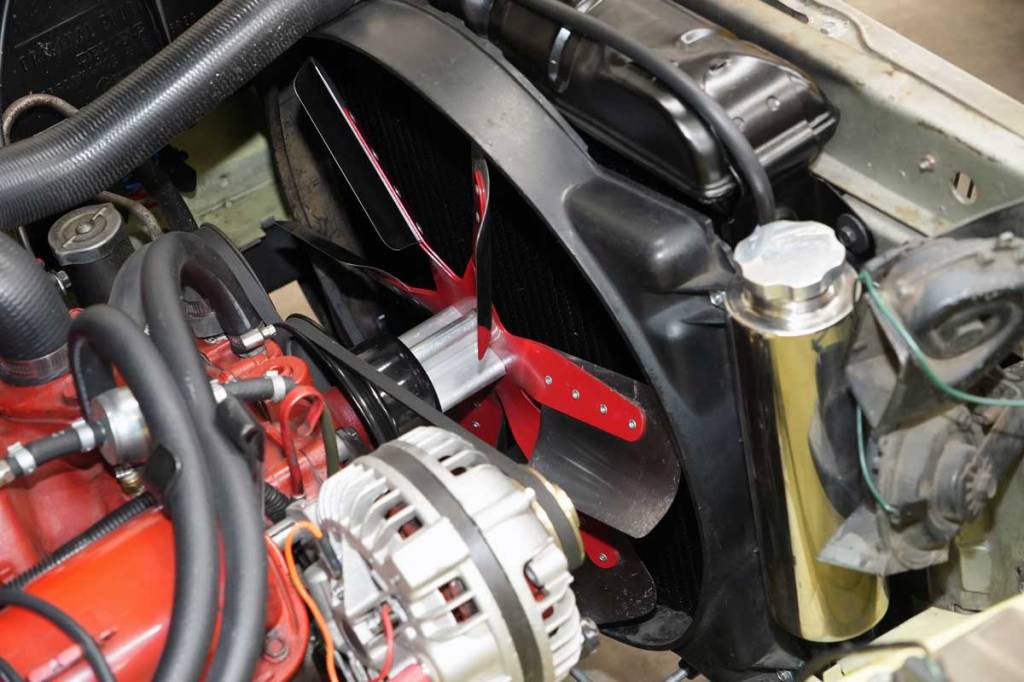
With a mechanical engine driven fan, real cooling efficiency comes from proper placement within the shroud. When positioned correctly, the fan and shroud function as a ducted airflow system. When positioned incorrectly, the fan becomes little more than a noisy windmill moving air everywhere except through the radiator core.
The difference is often determined by a simple component: the fan spacer.
The 50 Percent Rule
For maximum cooling efficiency, the fan blades should sit approximately half inside and half outside the shroud opening.
This means about fifty percent of the blade depth is inside the shroud and fifty percent is outside. That placement creates a strong pressure differential and ensures that air is drawn through the radiator core rather than recirculated inside the engine compartment.
When the fan is positioned too deep inside the shroud, air tends to circulate within the shroud cavity instead of being pulled through the radiator. When the fan sits too far outside the shroud, it pulls heated air from the engine bay rather than fresh air through the core. A fan mounted completely inside the shroud often looks correct but cools poorly. A fan without a shroud sacrifices a significant amount of idle and low speed cooling performance.
At highway speeds, forward motion forces air through the radiator. At idle and in traffic, the fan and shroud determine whether the system maintains temperature control.
Measuring and Selecting the Correct Spacer
Fan spacers are commonly available in increments ranging from one half inch to approximately two and one half inches. Proper selection begins with measurement rather than guesswork.
Measure the blade depth from the front edge of the blade to the rear of its curvature. If the blade depth measures two inches, the target is approximately one inch positioned inside the shroud opening.
Begin by mocking up the fan without a spacer. Install the shroud loosely and observe the blade position relative to the shroud opening. Based on that measurement, select a spacer that positions the blade centerline near the midpoint of the shroud opening.
Precision matters. Slight changes in position can significantly affect idle cooling performance.
Maintaining Proper Clearances
Before final installation, verify adequate clearances.
Maintain at least three quarters of an inch between the fan blades and the radiator core. Maintain at least one half inch between the blade tips and the shroud opening. Consider engine movement under torque, especially in high output applications. Engines with substantial torque can shift noticeably under load. Clearances that appear sufficient in the garage may disappear during acceleration.
Longer spacers increase leverage on the water pump shaft. Excessive spacer length can contribute to premature bearing wear. If more than approximately two and one half inches of spacing is required, reassess radiator placement or shroud depth.
Fixed Fans and Clutch Fans
The fifty percent positioning principle applies to both fixed blade fans and thermal clutch fans.
A thermal clutch fan offers advantages for street driven vehicles, including reduced parasitic drag and lower noise at highway speeds. When installing a clutch fan, confirm that both the blade depth and the clutch body maintain adequate clearance from the shroud under all operating conditions.
In general, the largest diameter fan that safely fits within the shroud opening will provide improved airflow at idle.
Sealing for Maximum Efficiency
Even a correctly positioned fan will lose effectiveness if air can bypass the radiator.
Seal gaps between the radiator and the core support. Ensure the shroud mounts tightly and that air cannot escape around the tanks. Air follows the path of least resistance. If there is an easier route around the radiator core, airflow will take that path instead of passing through the cooling fins.
Practical Application
On many late 1960s muscle car applications, an eighteen-inch seven blade fan paired with a deep factory style shroud and an appropriately sized spacer often achieves the correct half in, half out positioning. When combined with proper sealing and clearance verification, this configuration can maintain stable operating temperatures even in demanding street conditions.
Final Thoughts
Maximum cooling performance is not achieved by increasing fan speed alone. It is achieved by managing airflow.
When the fan is positioned half inside and half outside the shroud, the system functions as a ducted assembly, directing air through the radiator core where it is most effective. The correct spacer does more than reposition the fan. It improves airflow efficiency and stabilizes engine temperature under real world driving conditions.
Proper placement is simple, measurable, and highly effective.
 Mopower Garage
Leave a comment