
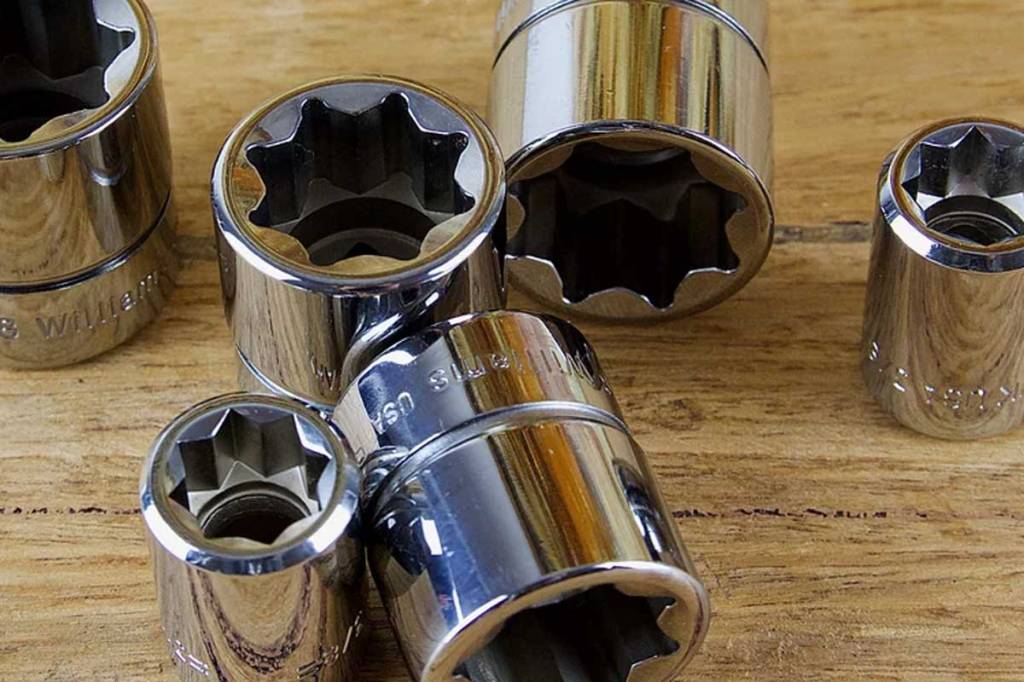
There is a certain kind of tool that sits quietly in the bottom drawer of a toolbox, rarely used, often overlooked, and occasionally misunderstood. The 8-point socket is one of those tools. At a glance, it looks like a compromise between the familiar 6-point and the common 12-point. In reality, it is something entirely different: a purpose-built solution for a problem most technicians only encounter occasionally but never forget.
The Tool You Did Not Know You Needed
Walk through any modern shop and you will see rows of 6-point sockets, the undisputed champions of strength and reliability. Next to them, the 12-point sockets offer convenience, slipping onto fasteners with minimal effort and saving time in tight quarters. But tucked away, often in a smaller, less-visited rail, sits the 8-point.
It is not there by accident.
The 8-point socket was designed specifically for square fasteners, a style that has largely disappeared from modern automotive design but still lingers in older machinery, industrial equipment, and the kinds of restoration projects that demand both patience and the right tools. If you have ever worked on vintage iron, you have likely run into one: a stubborn square-head pipe plug, maybe buried in a block or tucked into a differential housing, daring you to remove it without rounding it off.
That is when the 8-point earns its keep.
More Than Just a Middle Ground
It is easy to assume the 8-point is simply a compromise, more contact than a 12-point, but easier to position than a 6-point. That assumption misses the point entirely.
On a square fastener, the 8-point socket does something neither of the others can do effectively: it engages the flats correctly and completely. A 12-point will grab, but not with confidence. A 6-point will not fit at all. The 8-point, however, sits down firmly, distributing load across the flat surfaces rather than concentrating stress on the corners.
That difference matters. Especially when the fastener in question has been heat-cycled, corroded, and untouched for decades.
The Restoration Reality
In the world of classic cars, particularly older American iron, square-head fasteners are not uncommon. Drain plugs in engine blocks, transmission cases, and rear differentials often relied on square designs long before hex heads became the universal standard.
For the restorer, this creates a familiar scenario: everything is going smoothly until one stubborn plug refuses to cooperate. A pair of locking pliers might seem like a solution, but they introduce risk, slipping, rounding, and ultimately turning a simple task into a repair.
The 8-point socket eliminates that gamble. It turns a questionable operation into a controlled one. In that moment, it is not just another tool, it is the right tool.
The Double Box Advantage
The same principle extends to 8-point box-end wrenches. Often referred to as double box wrenches, these tools provide enclosed contact around the fastener, increasing grip while reducing the likelihood of slippage.
Compared to a 12-point box wrench, the 8-point version offers a more secure hold on square hardware. Compared to a 6-point, it provides more engagement position, an advantage when working in confined spaces where every degree of swing matters.
It is a small detail, but one that can make the difference between steady progress and mounting frustration.
Not for Every Job and That Is the Point
In modern automotive work, the 8-point socket is not a daily driver. High-torque applications still belong to the 6-point. Quick access and speed still favor the 12-point. The 8-point does not compete with these tools, it complements them.
Its role is narrower, but no less important.
It exists for the moments when nothing else fits quite right. When the fastener in front of you does not conform to modern expectations. When experience tells you that forcing the wrong tool onto the job will only make things worse.
The Quiet Specialist
Every experienced technician has a few tools like this, tools that are not flashy, not frequently used, but absolutely indispensable when the situation calls for them. The 8-point socket belongs in that category.
It is not about how often you use it. It is about what happens when you need it and do not have it.
Because eventually, every toolbox, and every technician, encounters a problem that requires more than the usual approach. And when that moment comes, the quiet specialist in the drawer is no longer overlooked.
It is essential.
 Mopower Garage
Leave a comment