
Published by Christopher J. Holley | Mopar History & Tech | March 2026
In the world of carburetors, where airflow and fuel delivery must work in perfect harmony, one small component quietly controls it all: the needle and seat. It is not flashy, it does not get talked about like boosters or accelerator pumps, but without it, even the best-tuned carburetor will not perform. In a Holley, the needle and seat assembly is the gatekeeper, responsible for maintaining the precise fuel level that everything else depends on.
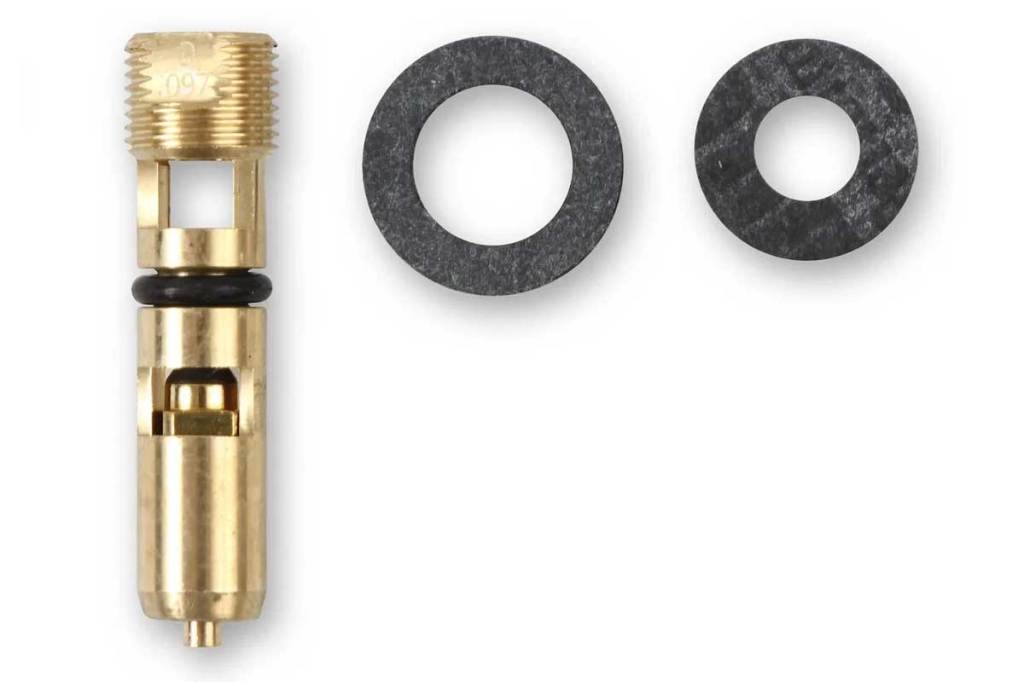
At its core, the system is simple. The seat is a threaded brass fitting that allows fuel into the bowl, while the needle is a pointed valve that seals against it. Together, they form a controlled inlet for fuel. But what makes this system effective is how it works in conjunction with the float.
As the engine runs, fuel is constantly being drawn from the float bowl. As the level drops, the float lowers with it, pulling the needle away from the seat and allowing fresh fuel to enter. Once the fuel level rises back to its set point, the float lifts the needle into the seat, shutting off the flow. This continuous cycle maintains a consistent fuel level, arguably the most important factor in keeping the air/fuel mixture stable.
That fuel level directly influences everything: idle quality, throttle response, and wide-open throttle performance. Too high, and the engine runs rich, often pushing fuel out of the boosters or vents. Too low, and the engine leans out, stumbling under load or starving for fuel at the top end. In other words, if the needle and seat is not doing its job, nothing else in the carburetor can compensate.
Like any precision component, the needle and seat is sensitive to its environment. A small piece of debris can prevent the needle from sealing, leading to flooding. Wear on the needle tip, especially in high-mileage or contaminated systems, can cause fuel to leak past even when it is “closed.” And in performance applications, excessive fuel pressure can literally overpower the needle, forcing it off the seat and overwhelming the bowl.
This is where Holley’s design stands out. Unlike many carburetors, most Holley models feature externally adjustable needle and seat assemblies. With a simple turn of the adjustment nut, the tuner can raise or lower the float level without disassembling the carburetor. It is a straightforward process, but one that has a profound impact on performance. Properly set, the fuel level should sit right at the bottom of the sight plug, ready to feed the engine without spilling over.
For high-performance and racing applications, the needle and seat becomes even more critical. Engines that demand higher fuel volume, especially those making repeated passes down the dragstrip, often require larger needle and seat assemblies to keep up. Sizes like .110-inch or .120-inch are common upgrades, ensuring the bowls stay full under sustained load. Pair that with a properly regulated fuel system, typically in the 5.5 to 7 psi range, and the needle and seat can do its job without being overrun.
In many ways, the needle and seat is a perfect example of how small parts make big differences. It does not add horsepower. It does not improve airflow. But it ensures the engine gets exactly the fuel it needs, exactly when it needs it. And in performance tuning, that kind of consistency is everything.
Ignore it, and you will chase tuning problems that never seem to go away. Get it right, and the rest of the carburetor falls into place.
 Mopower Garage
Leave a comment