Published by Christopher J. Holley | History & Tech |March 2026
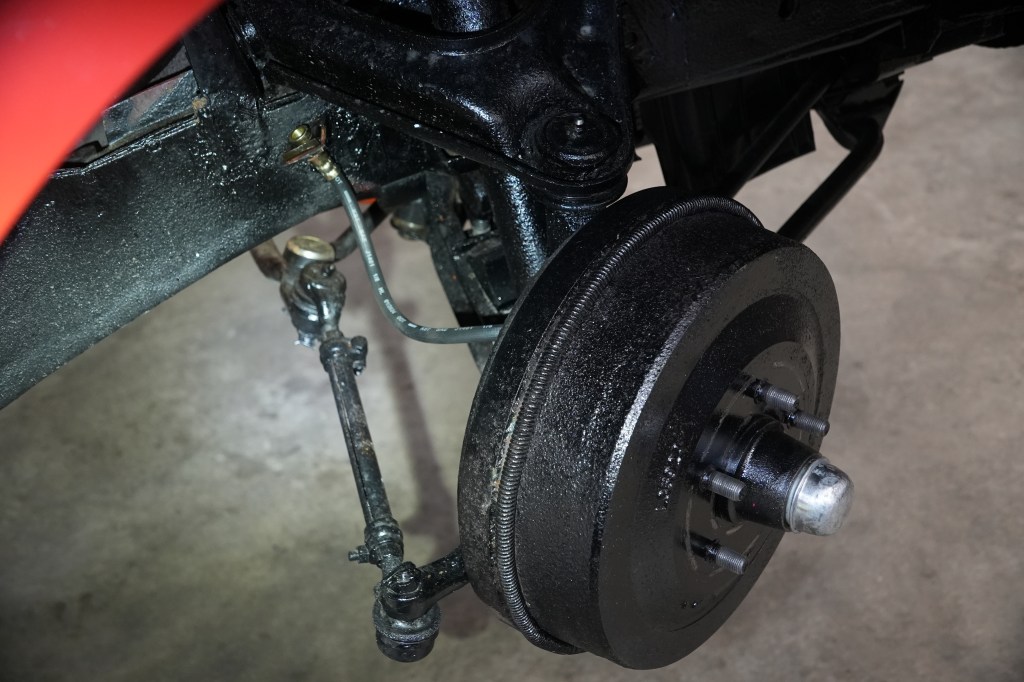
By the time the muscle car era hit full stride, Chrysler Corporation found itself at a crossroads, balancing proven engineering with a rapidly changing safety landscape. The familiar front drum brakes, long trusted on everything from family sedans to high-performance street machines, was nearing the end of its useful life. What followed was not a sudden disappearance, but a deliberate evolution that reshaped how Mopar vehicles stopped as dramatically as they accelerated.
In the early 1960s, Chrysler products across Plymouth, Dodge, and Chrysler relied heavily on 10- and 11-inch front drum brake systems. These brakes were robust and well-engineered, often using Chrysler’s duo-servo design that provided strong stopping power in a single hard application. However, their limitation became clear under repeated use. As heat built up inside the drum, stopping distances increased, pedal feel softened, and brake fade became a real concern, especially in high-speed or performance driving.
The introduction of Federal Motor Vehicle Safety Standard No. 105 in the late 1960s did not outlaw drum brakes, but it forced automakers to meet stricter standards for stopping distance, fade resistance, and wet braking performance. At the same time, Chrysler vehicles were becoming heavier, more powerful, and more capable of sustained highway speeds. The braking systems that had worked a decade earlier were no longer adequate for these new demands.
Chrysler began responding in the mid-1960s by offering front disc brakes as optional equipment. Early systems, often sourced from Bendix Corporation, appeared on higher-end and performance-oriented models. By 1966 through 1968, cars like the Plymouth Belvedere and Dodge Coronet could be equipped with front discs, and these systems quickly gained favor among police fleets and performance-minded buyers. Still, many muscle cars left the factory with front drums because they were less expensive and adequate for occasional use.
As horsepower escalated during the muscle car years, the limitations of drum brakes became more pronounced. A big-block-powered B-body could easily overwhelm its braking system under repeated stops. Disc brakes, with their ability to dissipate heat, shed water, and maintain consistent performance, proved to be a far superior solution. The difference was especially noticeable in real-world driving, where reliability and consistency mattered more than a single hard stop.
By the early 1970s, Chrysler made the transition clear. Front disc brakes became standard or nearly standard across much of the lineup. The Plymouth Road Runner and Dodge Charger adopted front discs, while E-body platforms such as the Plymouth Barracuda and Dodge Challenger were designed with disc brakes as a core part of their performance package. By the middle of the decade, front drum brakes had effectively disappeared from Chrysler passenger cars.
Chrysler’s disc brake systems retained a distinct engineering identity, incorporating both fixed and sliding caliper designs over time, typically using large single-piston calipers and substantial rotors suited to the size and weight of their vehicles. These systems proved durable, serviceable, and well-matched to both everyday driving and performance use.
Today, front drum brake cars remain an important part of Mopar history, especially in base models and early production vehicles. However, many enthusiasts choose to upgrade to factory-style front disc systems for improved safety and drivability. For Chrysler, the transition away from front drums was not an abandonment of tradition, but a necessary step forward, driven by performance, safety, and the evolving expectations of the American driver.
 Mopower Garage
Leave a comment