
Published by Christopher J. Holley | History & Tech |April 2026
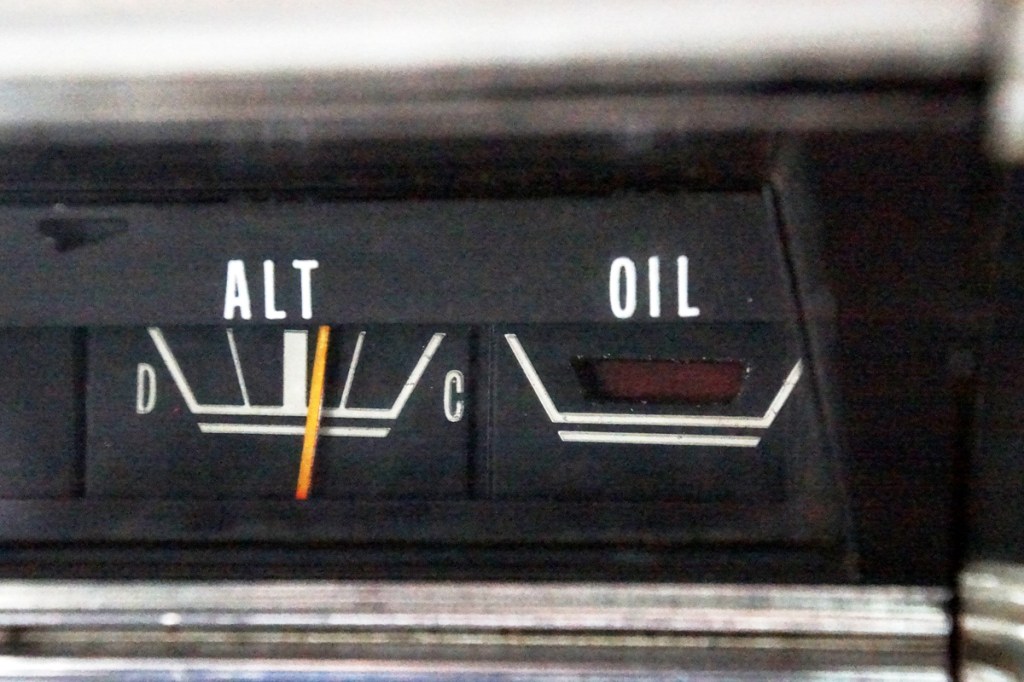
There was a time when the ammeter ruled the dashboard. Its needle swung with purpose: charge to the right, discharge to the left, giving drivers a sense that they were watching the car’s electrical lifeblood in real time. In an era of modest alternator output and simple wiring, that approach made sense. Today, it does not.
Modern driving conditions, even in vintage muscle, demand more from a charging system than ever before. Electric fans cycle on and off. Fuel pumps hum steadily in the background. Ignition systems are sharper, stronger, and less forgiving of voltage drops. Against that backdrop, the ammeter has become less of a useful instrument and more of a liability.
The fundamental issue is how an ammeter works. To measure current, it must be placed in series with the charging system. That means routing significant electrical load, often the full output of the alternator, through the gauge and its wiring. In many classic applications, especially in Mopar platforms, that path runs directly through the firewall bulkhead connector and into the dash. Decades ago, this was acceptable. Today, with higher-output alternators and aging connectors, it is a known weak point.
Heat builds. Resistance increases. Connections loosen. In the worst cases, wiring melts or ignites behind the instrument panel, far from easy reach and often without warning. The ammeter, once a symbol of control, becomes the very source of danger.
A voltmeter approaches the same system from a different philosophy. Instead of measuring current flow directly, it monitors electrical pressure and system voltage by connecting in parallel. It draws almost no current, places no load on the circuit, and requires none of the heavy wiring that makes the ammeter vulnerable. Installation is straightforward. A keyed power source, a solid ground, and the job is done.
More importantly, the voltmeter tells the story that matters.
With a quick glance, the driver can read the health of the entire charging system. A steady 12.6 volts with the engine off signals a fully charged battery. Bring the engine to life, and that number should rise into the mid-13 to mid-14 volt range, confirming that the alternator is doing its job. If the voltage sags below 12 while running, the system is falling behind. If it climbs too high, the regulator is overcorrecting. It is a broader, clearer picture, one that reflects real-world conditions rather than a single stream of current at a single point.
This clarity becomes even more valuable as electrical demands increase. High-output alternators, auxiliary cooling systems, electronic fuel injection, and modern ignition components all place dynamic loads on the system. An ammeter struggles to keep pace and, in many cases, becomes inaccurate or overstressed. A voltmeter, unaffected by load, continues to provide a stable and reliable reading.
There is also the matter of preservation. Many factory wiring systems, again, Mopar being a prime example, were never designed for sustained high current. By eliminating the need to route charging load through the cabin, a voltmeter reduces stress on bulkhead connectors, terminals, and aging harnesses. The result is not only improved safety, but also improved reliability across the entire electrical system.
None of this is to dismiss the ammeter entirely. For a period-correct restoration, its presence carries historical weight. Its movement has character. In controlled conditions, it can still provide useful directional information about charge and discharge. But even in those builds, many experienced restorers quietly rethink the execution, retaining the look while removing the risk.
On the street, however, the conclusion is difficult to ignore. The voltmeter does not just replace the ammeter; it refines the role of instrumentation itself. It trades raw measurements for meaningful insight. It removes danger without sacrificing awareness. And in a world where vintage machines are asked to perform in modern ways, that is not just an upgrade, it is a necessity.
 Mopower Garage
Leave a comment