Published by Christopher J. Holley | Mopar History & Tech | May 2026
Few changes transformed the appearance of Chrysler muscle cars more dramatically than the arrival of federally mandated 5-mph bumpers in the early 1970s. To many Mopar enthusiasts, the difference between a 1971 and a 1974 model can be summed up in one glance: sleek chrome elegance replaced by massive protruding impact systems.
But those oversized bumpers represented far more than styling changes. They marked the point where federal safety regulations, engineering realities, insurance concerns, and the fading muscle-car era all collided head-on.
The End of the Thin Chrome Era
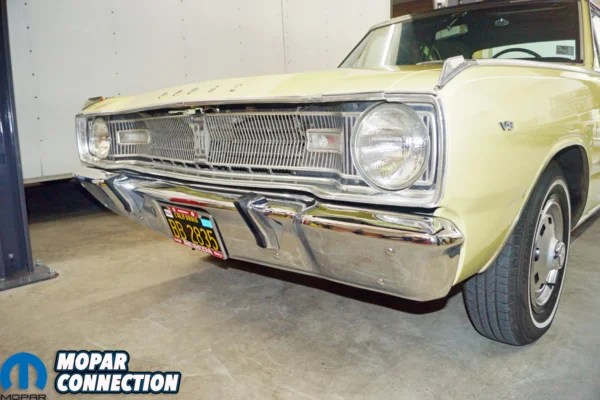
During the 1960s and early 1970s, Chrysler designers treated bumpers almost like decorative trim. Cars such as the 1970 Dodge Challenger R/T, 1971 Plymouth ‘Cuda, and 1968 Plymouth Road Runner carried thin chrome bumpers tucked tightly against the body.
The effect was clean, aggressive, and athletic. The bumper followed the body lines closely, helping emphasize the sharp Coke-bottle curves and low stance that defined Chrysler styling during the muscle-car years.
Pre-5 MPH Mopar Styling
These early bumpers were relatively simple pieces:
- Lightweight stamped steel
- Narrow mounting brackets
- Minimal reinforcement
- Little protection in an actual collision
In truth, they were never designed to survive impacts. A mild parking-lot bump could wrinkle sheet metal, crack a grille, or shove a bumper into a valance panel. But in the late 1960s, appearance mattered more than low-speed crash survivability.
Then Washington stepped in.
The Federal Mandate Arrives
By the early 1970s, insurance companies and federal regulators pushed automakers to reduce repair costs from minor accidents. The result was a new set of federal bumper standards requiring cars to withstand low-speed impacts without damage to safety systems.
Beginning in 1973, front bumpers had to survive a 5-mph impact. By 1974, both front and rear bumpers had to meet the standard.
For Chrysler engineers, compliance became a massive challenge almost overnight.
Cars originally styled around slim chrome bumpers suddenly needed:
- Reinforced structures
- Heavy mounting brackets
- Hydraulic impact absorbers
- Greater bumper-to-body spacing
The elegant integrated look of the muscle-car era disappeared almost immediately.
Enter the “Park Bench” Era
The transformation was especially dramatic on Mopars because Chrysler’s late-1960s styling had relied so heavily on tightly fitted bumpers. Once the new safety systems were added, the bumpers often appeared oversized and visually disconnected from the body.
Cars like the 1974 Plymouth ‘Cuda and 1974 Dodge Charger suddenly wore thick chrome bumpers mounted several inches away from the sheet metal. Large rubber guards and bumper fillers added even more visual bulk.
Post-5 MPH Mopar Styling
Enthusiasts quickly developed nicknames for the new systems:
- “Railroad ties”
- “Park benches”
- “Battering rams”
Yet despite the criticism, the new bumpers worked. Parking-lot damage dropped significantly, and the hydraulic bumper shocks could absorb surprisingly hard low-speed impacts.
More Than Just Looks
The new bumper systems changed far more than styling.
Weight increased substantially, often adding more than 100 pounds to a vehicle. Engineers had to redesign front structures, valances, grilles, and rear panels to accommodate the new crash systems.
The added mass also affected handling and performance at a time when muscle cars were already losing compression, horsepower, and aggressive gearing due to emissions regulations and rising insurance rates.
To many enthusiasts, the giant bumpers became visual symbols of the end of the original muscle-car era itself.
E-Body Evolution: The Perfect Example
No Mopar better illustrates the transition than the E-body platform.
Compare a 1971 Plymouth ‘Cuda to a 1974 Plymouth ‘Cuda and the difference is immediate.
The earlier car looks low, sleek, and tightly wrapped around its chassis. The later version appears heavier and more isolated from the road, largely because of the protruding bumper systems.
Ironically, today the 1973–74 E-bodies have developed their own following precisely because they look so unmistakably 1970s.
The Collector Perspective Today
Among collectors, pre-5-mph Mopars still command the strongest prices and widest admiration. The cleaner styling, lighter weight, and pure muscle-car proportions remain deeply appealing.
Yet appreciation for the later cars continues to grow.
Many enthusiasts now recognize the post-1973 Mopars as important transitional vehicles, cars caught between the wild horsepower wars of the late 1960s and the heavily regulated automotive landscape that followed.
They represent the final evolution of many classic Chrysler body styles before downsizing and corporate redesigns changed everything permanently.
And for anyone who lived through the era, those massive chrome bumpers remain unforgettable reminders of when federal regulations reshaped Detroit styling almost overnight.
 Mopower Garage
Leave a comment