Published by Christopher J. Holley | Mopar History & Tech | May 2026
There are few sounds in the performance world that are more unmistakable than the deep, uneven idle of a blown engine. Sitting at a stoplight, the car rocks gently against the converter while the exhaust pounds out a syncopated rhythm, part mechanical violence, part music. To enthusiasts, it is the sound of serious horsepower. But why do supercharged engines tend to “pulse” so dramatically at idle?
The answer lies in a combination of airflow dynamics, camshaft design, fuel delivery, and the unique behavior of the supercharger itself.
Camshaft: The Biggest Contributor
Despite what many people believe, the blower is not usually the primary reason for the pulsing idle. The real culprit is the camshaft.
Most supercharged street and race engines use aggressive cam profiles with extended duration and significant valve overlap. Overlap occurs when both the intake and exhaust valves remain open simultaneously for a brief period. At higher RPM, this improves cylinder filling and power production. At idle, however, it creates instability.
Instead of each cylinder receiving a smooth, consistent air/fuel charge, the engine experiences uneven combustion events. Vacuum levels fluctuate, airflow reverses direction momentarily, and the idle develops the signature “rump-rump-rump” cadence associated with radical performance engines.
In many blown combinations, the camshaft is specifically optimized to work with forced induction at higher engine speeds, making smooth idle quality a low priority.
The Supercharger’s Influence
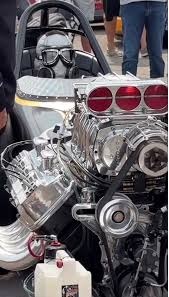
A roots-style supercharger, such as the classic 6-71 or 8-71 GMC-based blower, adds another layer to the equation. Unlike a centrifugal supercharger, which builds boost progressively with RPM, a roots blower is constantly moving air anytime the engine is running.
At idle speeds, rotor movement creates pressure fluctuations and airflow pulses within the intake manifold. Combined with low engine vacuum and cam overlap, the result is an engine that seems to “breathe” unevenly while idling.
On carbureted blower setups, fuel distribution can also vary slightly between cylinders, further exaggerating the pulsing effect. The blower may be moving substantial airflow, but at low RPM the engine is not using it efficiently, creating the choppy idle that enthusiasts instantly recognize.
Fuel and Timing Characteristics
Blown engines are often tuned rich at idle for cooling and detonation protection. Rich mixtures tend to burn less consistently at low engine speeds, especially with large camshafts and weak vacuum signals.
Ignition timing also plays a role. Many supercharged combinations use substantial initial timing advance or locked timing strategies to improve throttle response and stabilize combustion. The sharper ignition events contribute to the crisp, hard-edged exhaust note commonly associated with blown engines.
Mechanical Personality
Not all supercharged engines idle this way. Modern EFI-equipped centrifugal supercharger systems can idle nearly as smoothly as stock engines thanks to sophisticated fuel and spark control.
The dramatic pulse is most commonly associated with old-school roots-blown V8s, especially those using carburetors, tunnel rams, and aggressive mechanical camshafts. In those combinations, idle quality becomes secondary to power production and visual attitude.
More Than Just a Sound
For decades, the pulsing idle of a blown engine has symbolized raw American performance. Whether it is a street-driven big-block Chevrolet, a roots-blown Ford coupe, or a towering, injector-equipped Mopar Hemi, the lopey cadence tells everyone nearby the engine was built with one goal in mind: making power.
It is not smooth. It is not refined. But that rhythmic pulse remains one of the most intoxicating sounds in motorsports culture.
 Mopower Garage
Leave a comment